RUNNING HEAD: 5-Year Strategic Plan – Lenovo.
1
5-Year Strategic Plan – Lenovo.
Baxter Smith, Finn Shepherd, Luiza Oliviera
Webber International University
Strategic Thinking in Organizations (MBA 690)
Dr. Herb Nold
January 27th, 2020
RUNNING HEAD: 5-Year Strategic Plan – Lenovo.
2
Introduction
This report will provide the board of directors and senior management, research,
analysis, and informed strategic opportunities, that can help Lenovo continue their dominance
within the industry for the foreseeable future. Included within this report, an industry analysis,
SWOT analysis, market analysis, strategic objectives, implementation plan, risk analysis, and a
financial analysis will be conducted. This will provide meaningful data via secondary research to
the board of directors and senior management of Lenovo.
Strategic Analysis
Company History
Legend Holdings was founded in 1984, Beijing, China (Lenovo, 2020a). With an
initial outlay of RMB200,000 ($25,000), Lenovo’s founding chairman Liu Chuanzhi, together
with 10 like-minded colleagues launched the new technology developer (Lenovo, 2020a). Lenovo
brand came into existence only in 2004 during a company name change. Prior to completing the
acquisition of IBM’s personal computing division, making it a new international IT competitor
and the third-largest personal computer company in the world (Lenovo, 2020a). Lenovo has had
fruitful relationships with the winter and summer Olympic games and had one of their designs
selected by the Beijing organizing committee for the Olympic torch in 2008 (Lenovo, 2020a).
Lenovo has seen growth larger than that of the market for more than four years because their
exceptionally engineered products are meant for those who do. In 2014, Lenovo acquired Motorola
Mobility. By adding Motorola, Lenovo became the third largest smartphone company in the world
(Lenovo, 2020b).

RUNNING HEAD: 5-Year Strategic Plan – Lenovo.
3
Lenovo is a fortune 500 company and has seen continued progress with their ranking.
As of 2019, Lenovo was ranked #212 in “Fortune’s Global 500 List” and was also in the Fortunes
“World’s Most Admired Company’s” list (Lenovo, 2020b). Currently, Lenovo employs 54,000
people and are in 160 countries, they are currently the world’s largest PC vendor (Lenovo, 2020b).
SWOT Analysis
The SWOT analysis is an acronym and simply stands for strengths, weaknesses,
opportunities and threats (Dyson, 2004). The analysis is split into four sections and helps present
and identify each component clearly (Dyson, 2004). The strengths and weaknesses are areas of a
company that are considered as internal, areas that the company itself has jurisdiction over
(location, reputation) (Hill and Westbrook, 1997). Opportunities and threats are considered as the
external areas where the company does not have control over (competitors, suppliers) (Hill and
Westbrook, 1997). It is important for companies to constantly use this type of analysis to help
identify each area with the ever changing business environment (Piercy and Giles, 1989).
Moreover, a SWOT analysis is a powerful tool to aid in the development of business strategy (Hill
& Westbrook, 1997).
Strengths
• Diverse Portfolio
• Fastest growing PC maker
• Strong Financial Performance
• Supply Chain Management
• International Growth
Weaknesses
• Late Entrant in Key Areas
• PC Market Decline
• Lagging Behind in Marketing
Opportunities
• Operations Relocation
• Digital Marketing
• Acquisitions
Threats
• Aggressive Competition
• Trade Wars
• Economic Fluctuations
RUNNING HEAD: 5-Year Strategic Plan – Lenovo.
4
Table 1. SWOT analysis for Lenovo Group Limited
Strengths. In the case of Lenovo, the six main strengths of the organization are, a diverse
portfolio, fastest growing PC maker, number one vendor for PC’s based on units shipped, strong
financial performance, good supply chain management and large international growth (see Table
1). Lenovo has a diverse product portfolio; this is Lenovo’s main strength attribute. Lenovo’s large
product portfolio gives them a competitive advantage over their rivals as they are in a multitude of
different markets. This is favorable for the company as, if there is a lag in a market of one product
type, there will still be revenue generated in other markets where the products are not interrelated.
Additionally, Lenovo is the fastest growing PC maker in the world (Pratap, 2019). In its infant
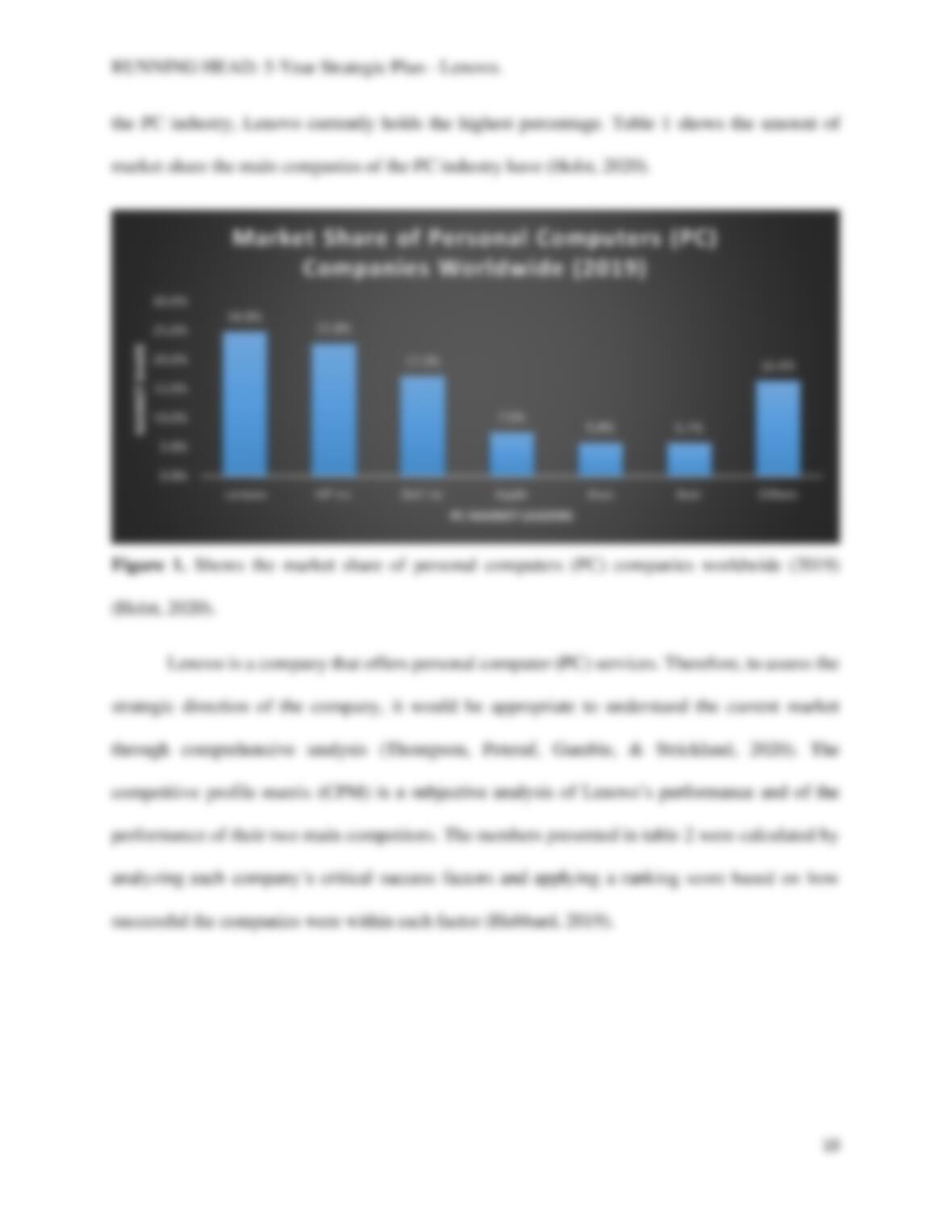
years as a company however, Lenovo has amassed a market share of 24.8% (Holst, 2020). This is
predominantly due to their core competency of providing quality products at affordable prices,
which has left their sales rising.
Lenovo has recorded strong financial performance for the fiscal year 2018/19.
Lenovo, recorded $51 billion (Lenovo, 2020c) revenue which was an increase of over $5 Billion
since 2017/18. Attributed to this success is Lenovo’s focus of improving product quality over the
last several years and thus has put them as a leading challenger to companies such as, HP, Dell
and Apple (Pratap, 2020). Lenovo also displays levels of strength in their supply chain
management. Not only are Lenovo striving to increase product quality via the selection of suppliers
they use and the quality of the raw materials that make their products. But, Lenovo also are
encouraging suppliers to achieve OHSAS 18001 certification to ensure safe workplace
environments for all who come into contact with their product (Pratap, 2019).
Lenovo has incredible international growth considering its limited lifespan. The company
sells its products across 160 countries (Lenovo, 2020b). China is its leading market; Lenovo also
RUNNING HEAD: 5-Year Strategic Plan – Lenovo.
5
thrives in the Americas, and the Asia Pacific. Lenovo has operations in over 100 countries
(Lenovo, 2020b), which can be a significant strength when it comes to governmental
policies/regulations.
Weaknesses. Lenovo has three major weaknesses. They are late entrants in key areas.
Specifically, the smartphone industry. Although Lenovo has built a leading position in the personal
computing industry (Holst, 2020), they are lagging severely behind competitors in the smartphone
industry (Pratap, 2019). For the first time in 2018, the company reported profits from its mobile
business since it acquired Motorola Mobility in 2014 (Lenovo, 2020d). Moreover, mobile
computing is growing and the increase in usage and capabilities of smartphones leads to Lenovo’s
next weakness, the decline in the PC industry. Although it is great Lenovo are the leading company
within the PC industry, a decline in the industry could hinder the profitability of the company, and
thus increases the importance of strengthening their mobile computing products. A final weakness
of Lenovo is how they lag behind in terms of marketing. Lenovo are not as aggressive as their
competitors within the industries. Their ‘relaxed’ approach to marketing strategies limits their
ability to annunciate their brand like Apple and HP which you see advertised everywhere. Lenovo
pride themselves on their product quality and competitive pricing strategy, but if they do not
market their products effectively it could ultimately end up in the company losing market share
(Pratap, 2019).
Opportunities. Opportunities for Lenovo include, Operations Relocation, Digital
Marketing, and Acquisitions. While Lenovo is currently performing to extraordinary levels,
political and governmental regulations and policies are ever changing. With this in mind, Lenovo
must consider their Operations, Beit manufacturing to distribution. For example, the US-China
trade war and all of the potential tariffs that may come into effect through exporting to the US
RUNNING HEAD: 5-Year Strategic Plan – Lenovo.
6
from China. Lenovo currently operates in 100 countries and therefore must consider opportunities
to shift operations to favorable locations in order to avoid such tariffs. Moreover, this identifies an
additional opportunity, that of acquisitions. Lenovo have seen success in acquisitions since their
origination, with the elected tariffs it may be beneficial to acquire other companies that may
alleviate any financial pressures that would come with these tariffs or the trade-war. A final
opportunity for Lenovo is that of digital marketing (Pratap, 2019). Digital marketing is an ever-
growing marketing technique and has become the main marketing channel for millions of
businesses worldwide (Pratap, 2019).
Threats. Lenovo must consider the threats to their company and its profitability.
Aggressive competition is a threat within the industry Lenovo are in. HP, Dell and Apple are all
aggressive players within the industry and market their products to a high level, this is a threat to
Lenovo as it could potentially be the reason to a drop in market share in the future. Furthermore,
these companies invest heavily in R&D and product quality in order to stay at the top of their
game. This is a threat to Lenovo, especially if they continue to be a late adopter to key areas. Trade
wars as briefly mentioned prior are also of concern or threat to Lenovo. The US-China trade war
could have significant impact of the profitability of Lenovo due to an increase in operational costs
(Pratap, 2019). Finally, economic fluctuations are also a threat for Lenovo. Lenovo is global so
they are directly affected by global economic changes and currency fluctuations can affect
Lenovo’s profitability. Currency fluctuations have worsened the profitability of Lenovo, in
2018/19 Lenovo saw their profit affected by ($112 Million), which was double that of the previous
year (Lenovo, 2020d).
RUNNING HEAD: 5-Year Strategic Plan – Lenovo.
Industry Analysis
The computer hardware industry that Lenovo is in consists of a significant amount of
companies, as mentioned earlier, such as Apple, Dell, HP, and Samsung (Bhasin, 2018). Each one
of these companies present a competitive advantage that aim to outdo competition, which allow
the organization to be successful in a specific area (Rice, 2010). It is imperative for managers to
perform a competitive advantage analysis within the industry in order to evaluate external threats
with the purpose of develop new strategies to overcome the risks (Rice, 2010). Michael Porter
developed the Porter’s Five Force Model that helps managers to easily identify external risks and
analyze threats within the industry (Rice, 2010). Lenovo’s analysis of the five forces model
exhibits the industry competition and intensity, threats of substitutes products and services, power
of suppliers, threat of new entrants, and power of buyers (Rice, 2010).