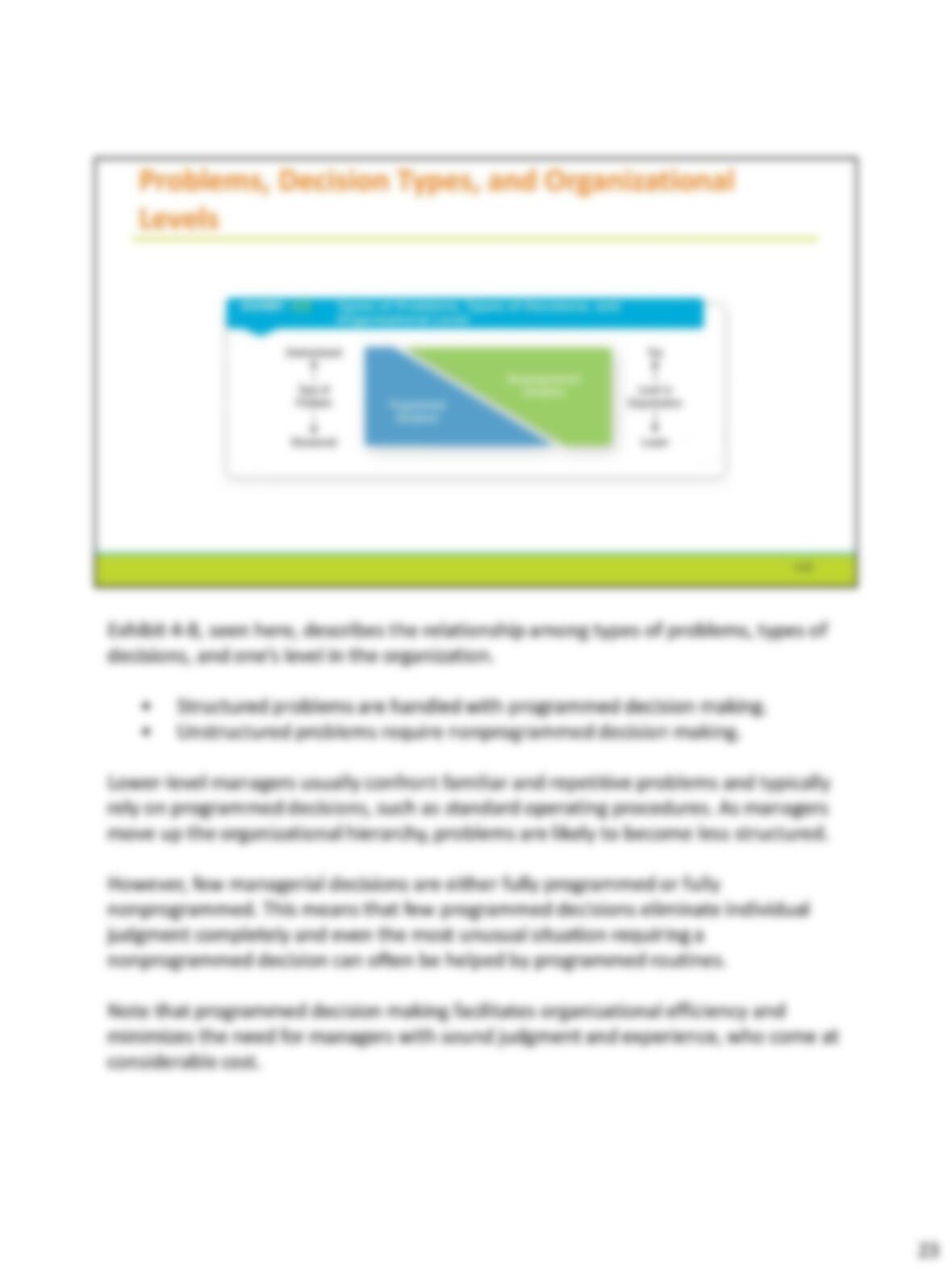
4Chapter
Making
Decisions
4-1
1

Learning Objectives
•Describe the decision making process.
•Explain the three approaches managers can use to make
decisions.
•Describe the types of decisions and decision-making
conditions managers face.
•Discuss group decision making.
•Discuss contemporary issues in managerial decision making.
4-2
After studying this chapter, you will be able to:
•Describe the decision making process.
•Explain the three approaches managers can use to make decisions.
•Describe the types of decisions and decision-making conditions managers face.
•Discuss group decision making.
•Discuss contemporary issues in managerial decision making.
2
4-3
3
How Do Managers Make Decisions?
4-4
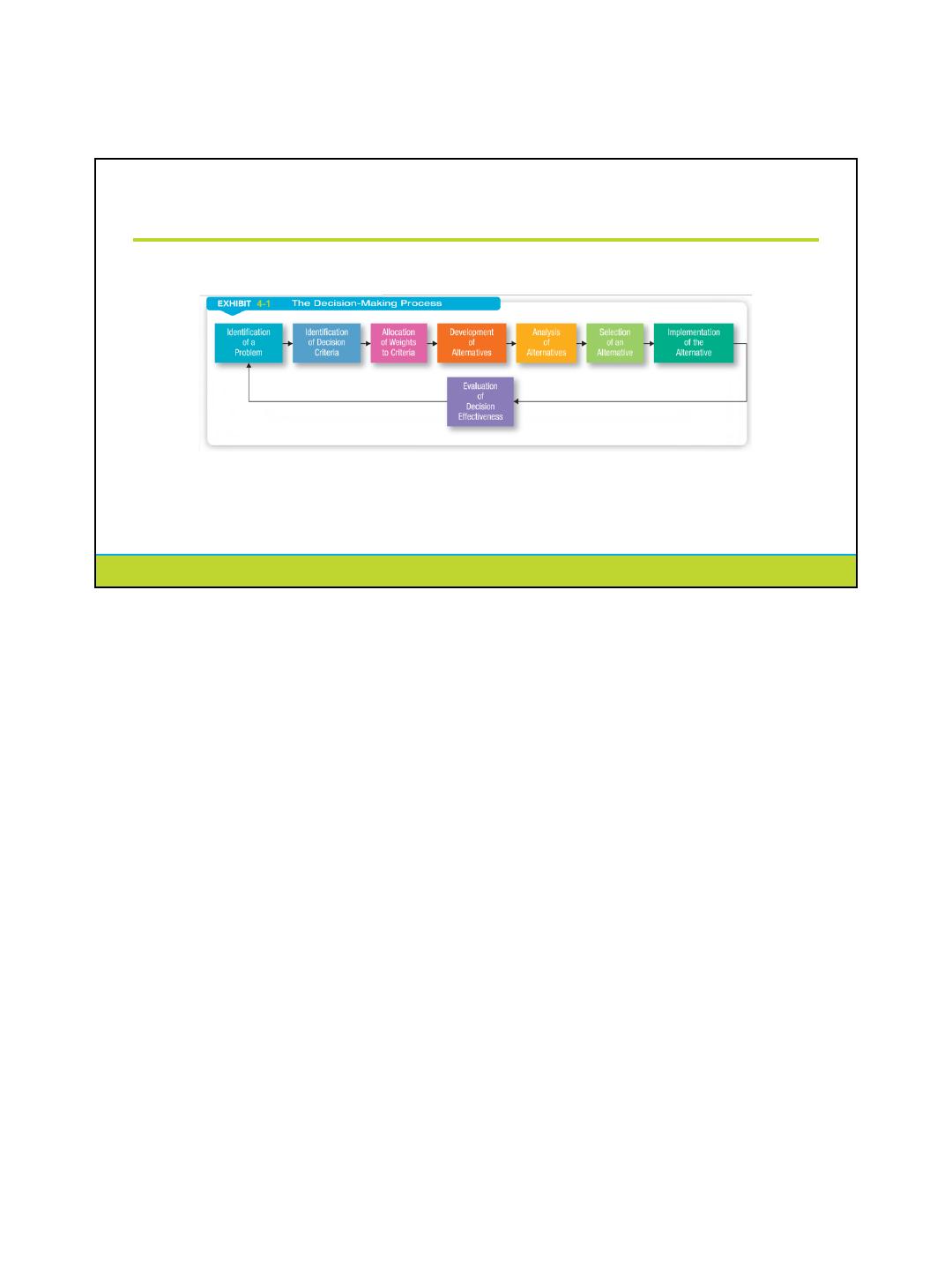
Decision making can be viewed as an eight-step process that involves identifying a
problem, selecting an alternative, and evaluating the decision’s effectiveness.
This process can be used for making both individual and group decisions, and
decisions that range from planning your spring break to complex planning for NASA.
Here we see the eight steps, starting from the left with:
Step 1: Identification of a problem
Step 2: Identification of Decision Criteria
Step 3: Allocation of Weights to Criteria
Step 4: Development of Alternatives
Step 5: Analysis of Alternatives
Step 6: Selection of an Alternative
Step 7: Implementation of the Alternative, and
Step 8: Evaluation of Decision Effectiveness.
4

What Defines a Decision Problem?
Problem –A
discrepancy
between an
existing and a
desired state of
affairs.
4-5
Step 1 in the decision-making process begins with the identification of a problem—
that is, a discrepancy between an existing state of affairs and the desired state of
affairs.
How do managers become aware of such a discrepancy? They have to compare the
current state of affairs with some standard, which can be past performance,
previously set goals, or the performance of another unit within the organization or in
another organization. If, for example, a car is no longer worth repairing, then the best
decision may be to purchase another car.
5

Factors in the Decision-Making Process
Relevant decision criteria:
•Price
•Model (two-or four-door)
•Size
•Manufacturer
•Optional equipment
•Fuel economy, or
•Repair records.
1-6
Once a manager has identified a problem that needs attention, he or she must
identify the decision criteria that will be important in solving the problem. This is
Step 2 in the decision-making process.
In the case of replacing one’s car, the car’s owner assesses the relevant criteria, which
might include price, model (two-door or four-door), size (compact or intermediate),
manufacturer (Japanese, South Korean, German, or American), optional equipment
(navigation system or side-impact protection), fuel economy, and repair records.
Note that in this step in the decision-making process, what is not identified is as
important as what is. Therefore, if a decision maker doesn’t identify a particular
factor in Step 2, that factor is deemed irrelevant.
6

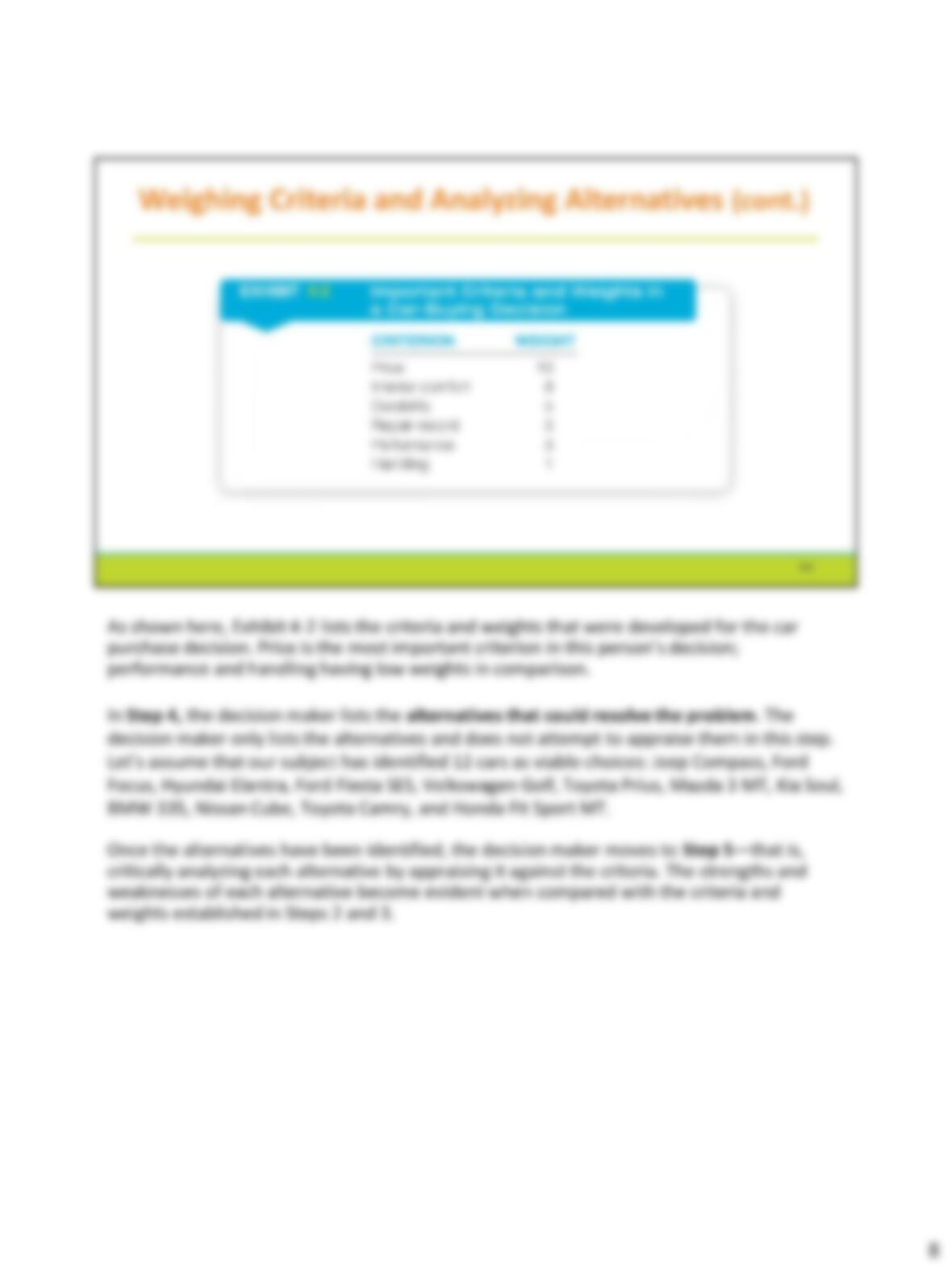
Weighing Criteria and Analyzing Alternatives
To weigh criteria:
1. Give the most important criterion a
weight of 10.
2. Compare remaining criteria against that
standard to indicate their relative
degrees of importance.
4-7