ARTICLE IN PRESS
JID: MECH [m5G;November 25, 2015;20:1]
Mechatronics 000 (2015) 1–10
Contents lists available at ScienceDirect
Mechatronics
journal homepage: www.elsevier.com/locate/mechatronics
Non-singular terminal sliding mode controller: Application to an
actuated exoskeleton
T. Madani a,∗, B. Daachib, K. Djouania,c
aLISSI Lab., University of Paris-Est Creteil, Creteil, France
bLIASD Lab., University of Paris 8, Saint Denis, France & CNRS-AIST JRL, UMI 3218/CRT, Tsukuba, Japan
cF’SATIE/TUT, Pretoria, South Africa
article info
Article history:
Received8July2014
Accepted 26 October 2015
Available online xxx
Keywords:
Nonlinear control
Non-singular terminal sliding mode
Finite-time convergence
Exoskeleton
abstract
This paper presents a robust controller of an active orthosis used for rehabilitation purposes. The system is
composed of the orthosis worn by the shank and has a complex dynamical model. No prior knowledge is con-
sidered on the dynamical model and the flexion/extension movements considered are of sinusoidal form and
are generally defined by the doctor. The used non-singular terminal sliding mode technique permits to have
a finite time convergence. The experimental results have been conducted online on an appropriate dummy
and then on three healthy subjects. A comparison of performances obtained by the proposed approach with
those obtained by a conventional controller has also been realized. Several situations have been considered
to test the robustness and it has been concluded with the effectiveness of the developed controller.
© 2015 Elsevier Ltd. All rights reserved.
1. Introduction
Currently, exoskeletons/orthoses represent a considerable part of
robotics research. These wearable robots are used in various fields
such as rehabilitation, assistance and can sometimes replace com-
pletely the upper or lower limbs of human. In addition, exoskele-
tons can also be used to improve comfort and help on various daily
tasks (gardening, carry heavy loads, climb stairs, walk longer, etc.).
Some of main problems considered for this type of robot are related
to control, identification of dynamic parameters or behavior and to
observe some physical phenomena that can improve exoskeletons
performance. Now, the challenge is to improve the cognitive abilities
of exoskeletons to enable them to learn, adapt and make decisions
based on their own mistakes in the same way than humans. In liter–
ature, it can be found several exoskeletons/orthoses developed and
used for various applications. The University of Agriculture and Tech-
nology of Tokyo has designed an exoskeleton to help the wearer to
perform agricultural work considered difficult and tough [7].Another
kind of exoskeleton namely “Hercules” has been made to improve the
performance of soldiers.1The University of Berkeley has recently de-
veloped a lower limb exoskeleton called BLEEX that allows the holder
to carry heavy loads [12]. Furthermore, Refs. [4,9] constitute a good
state of the art on the exoskeletons and their applications.
∗Corresponding author. Tel.: +33 141807335; fax: +33 141807320.
E-mail addresses: tarek.madani@u-pec.fr (T. Madani), bd@ai.univ-paris8.fr
(B. Daachi), djouani@u-pec.fr (K. Djouani).
1http://www.army-technology.com/features/featurefrench-hercule-robotic-
exoskeleton.
To allow the exoskeleton to meet the needs of the wearer, it is nec-
essary to apply an appropriate control law. The complexity of the sys-
tem dynamics consisting of the exoskeleton and its wearer associated
with external perturbations make the traditional controllers ineffi-
cient. This complexity has led researchers to propose a variety of ap-
propriate controllers. Some control schemes are based on the prelim-
inary step of identifying the dynamic parameters of the set consisting
of the exoskeleton and its wearer. Other approaches are adaptive and
are dedicated to generic exoskeletons designed to be worn by humans
of different morphologies. An example of such controllers is based on
neural networks [10,25]. The universal approximation of neural net-
works [5,21] is one of their advantages. However, neural approaches
require generally offline learning step in order to avoid undesirable
behavior of the exoskeleton during the initialization step. In [1],the
authors use a dynamical model of the upper limb exoskeleton to am-
plify the human power. In that human-robot cooperation, it is rarely
possible to know the exact dynamical model and consequently the
scope of this approach is reduced. Several works on nonlinear control
of exoskeletons [8,11] can be also found.
Sliding mode controllers having the advantage of robustness
against external disturbances and model uncertainties, have been
widely applied to the robotic systems [19,22,23]. The classic sliding
mode controllers use a linear sliding surface and the convergence of
the system’s states is asymptotic. Terminal Sliding Mode (TSM) tech-
nique based on a non-linear sliding surface is proposed to ensure, in
finite time, the stability of the closed loop system [16,18,20].TheFast
Terminal Sliding Mode (FTSM) surface has been introduced [6,13,26]
to further reduce the finite-settling-time. The Non-singular Terminal
http://dx.doi.org/10.1016/j.mechatronics.2015.10.012
0957-4158/© 2015 Elsevier Ltd. All rights reserved.
Please cite this article as: T. Madani et al., Non-singular terminal sliding mode controller: Application to an actuated exoskeleton, Mechatronics
(2015), http://dx.doi.org/10.1016/j.mechatronics.2015.10.012
2T. Madani et al. / Mechatronics 000 (2015) 1–10
ARTICLE IN PRESS
JID: MECH [m5G;November 25, 2015;20:1]
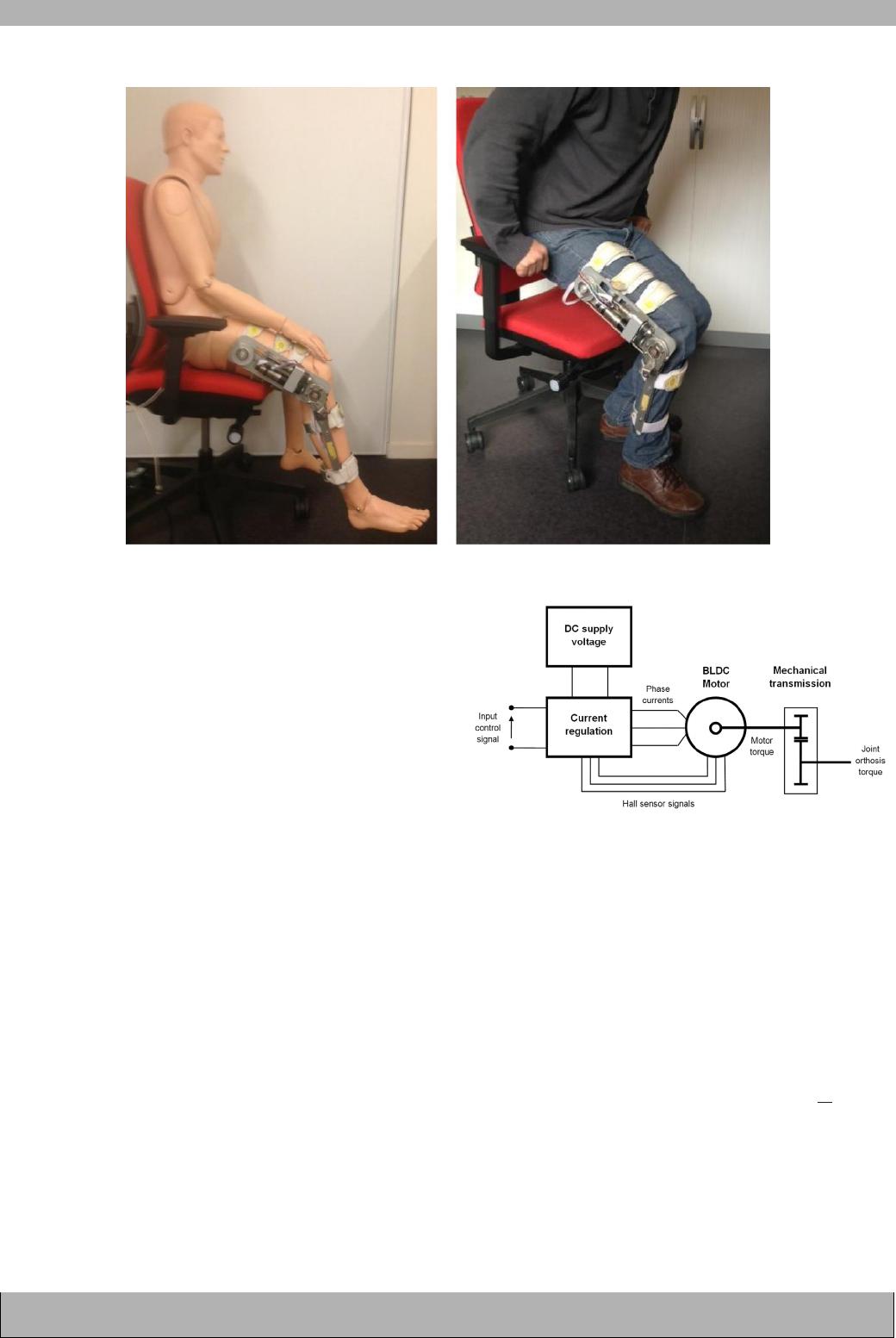
Fig. 1. The dummy and human wearing an actuated knee joint orthosis (EICoSI).
Sliding Mode (NTSM) has been proposed [2,14,15] to overcome the
classical singularity problem of the conventional TSM. Furthermore,
a boundary layer augmented sliding mode controller is proposed in
[3] for trajectory tracking of a robotic orthosis. Even if the obtained
results are good, the stability of the system in closed loop is not
ensured.
In this article, it is proposed to construct and experiment a NTSM
controller for a powered knee orthosis. The goal of the proposed con-
troller is to show the effectiveness of a sliding technique that ensures
the convergence toward the sliding surface and avoiding any singu-
larity problem. Surely it can be found other versions of this technique
in the literature but as given in the article, it is unique with a par–
ticular way to compute the finite time convergence. In fact, a new
optimization strategy at the vicinity of the singularity is proposed.
This allows to compute the minimum reaching time to the sliding
surface. Furthermore, this technique requires no prior knowledge on
the dynamic model. Also, the advantage of this method over other
methods is its robustness against parameter uncertainties and exter–
nal disturbances. The system considered in this paper, consisting of
the orthosis and knee of the wearer, has a complex dynamic that is
difficult to mobilize by equations. For safety reasons, it is very impor–
tant to control it by techniques including a very short transient toler–
ated by the standards set by the doctor. This is precisely what offers
the NTSM technique that is used in this work. As this technique is al-
most never used in the field of control of exoskeletons, the presented
work proposes a control taking into account the state of the carrier
of the exoskeleton that can be active or completely passive (no mus-
cular effort developed). So the proposed controller is firstly tested on
an appropriate dummy and is only after eliminating all the risks that
application can be made. Final validation is performed on a healthy
subject.
The paper is organized as follows: in Section 2, the exoskeleton
used for the experiments and formulate the considered problem are
described. Section 3 deal with the analysis and controller proposed
stability. The experimental results and their analysis are given in
Section 4. Finally, Section 5 is dedicated for the conclusion and future
work.
Fig. 2. Electrical architecture of the joint orthosis actuator.
2. Active orthosis system
The EICoSI (Exoskeleton Intelligently Communicating and Sensi-
tive to Intention) is used to carry out the experimental validations
of the proposed controller. EICoSI is an active knee-joint orthosis
developed in LISSI Laboratory (Laboratoire Images, Signaux et Sys-
tèmes Intelligents) of University Paris-Est Créteil (UPEC), France. Two
jointed segments compose the considered actuated orthosis, upper
and lower. The mechanical part and the actuator are placed on the
upper part of the orthosis. The torque generated by the orthosis re-
alizes flexion/extension movements of the lower part, formed by the
dummy shank and the lower part of the orthosis. Moreover, the knee
joint is constrained by a range of motion between 0 and 2π
3for safety
reason. In Fig. 1, a dummy and a human wearing the used actuated
knee joint orthosis are presented.
2.1. Electrical part
The joint of the orthosis is actuated by a brushless DC motor
(BLDC). A power supply and an adequate electrical system are used
to provide the regulation for the current in the motor. A mechanical
Please cite this article as: T. Madani et al., Non-singular terminal sliding mode controller: Application to an actuated exoskeleton, Mechatronics
(2015), http://dx.doi.org/10.1016/j.mechatronics.2015.10.012
T. Madani et al. / Mechatronics 000 (2015) 1–10 3
ARTICLE IN PRESS
JID: MECH [m5G;November 25, 2015;20:1]
Fig. 3. Position of the joint orthosis.
transmission is used to increase the orthosis applied torque. Fig. 2
shows the schematic diagram of the used electromechanical system.
Assumption 1. The time constant of the electrical system is negligi-
ble compared to the mechanical time constant.
According to regulation system characteristics of the BLDC motor
and the Assumption 1, the following equation can be written:
τa=cmi(1)
where iis the electrical current of the BLDC motor, τais the applied
torque and cmis a positive constant.
2.2. Mechanical part
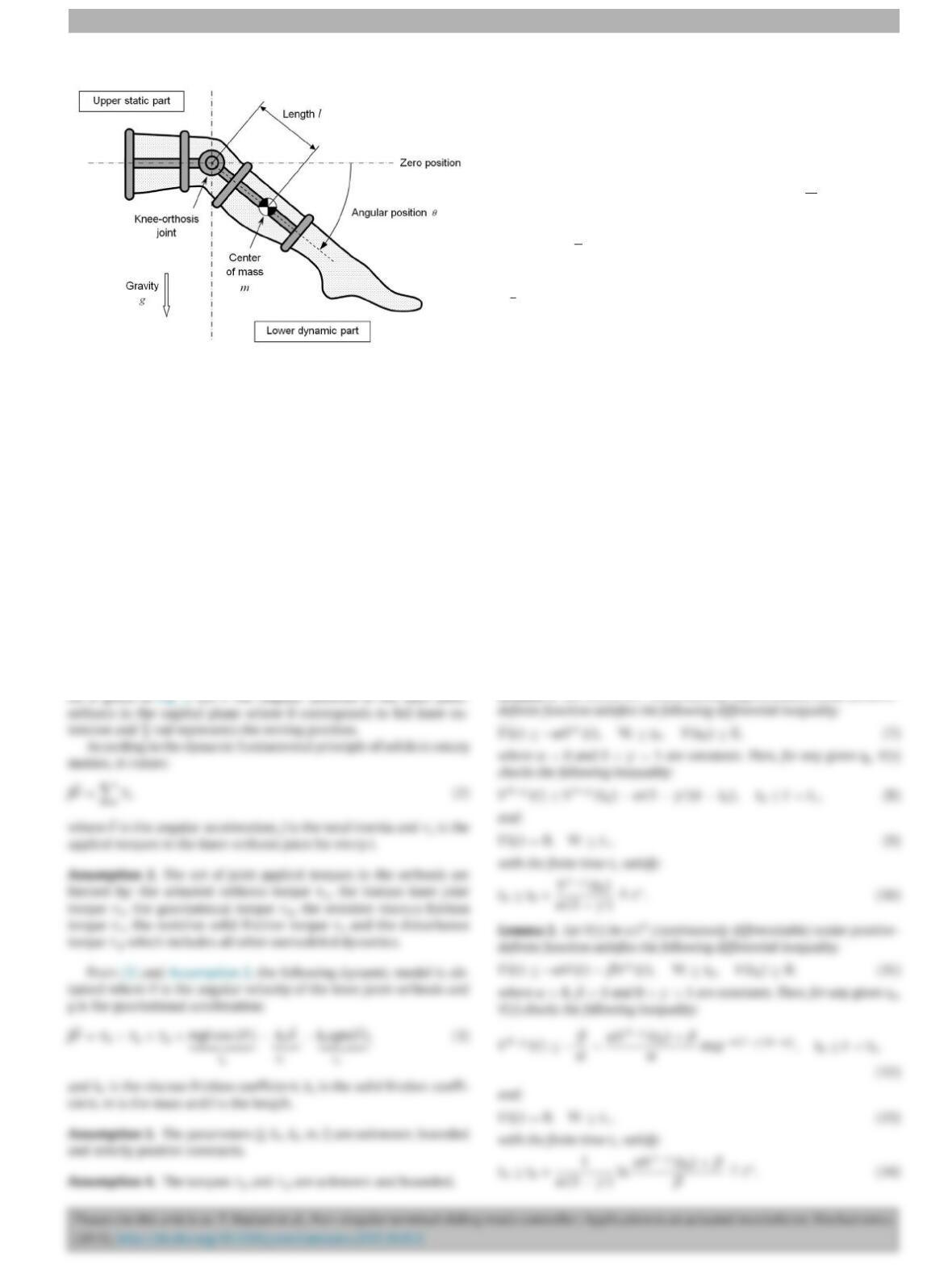
The mechanical structure scheme of the considered active ortho-
2.3. Dynamic model
The following dynamic model of the whole system is obtained us-
ing (1) and (3):
¨
θ=f(θ,˙
θ,t)+ϕu(t)(4)
with u=iis the electrical current control input, ϕ=cm
Jand the func-
tions f(θ,˙
θ,t)∈Ris given by:
f(θ,˙
θ,t)=1
J[mgl cos (θ) −kv˙
θ−kssgn(˙
θ)+τk(t)+τd(t)](5)
According to Assumptions 3 and 4, it is obvious to write:
1
λ≤ϕ
|f(θ,˙
θ,t)|≤a0+a1|cos (θ)|+a2|˙
θ|P(θ,˙
θ) (6)
where a0,a1,a2and λare adequate positive constants.
One can synthesize the control law forcing the states {θ,˙
θ}of a
orthosis to follow the desired trajectory by using the non-singular
terminal sliding mode technique.
3. Sliding mode controller design
Our objective is to design a sliding mode control law for the actu-
ated orthosis. The controller generates the control signal u(t)ensur–
ing that the real position θ(t) tracks the desired one θd(t) in finite-
time. This can be done in two main steps:
•Select the NTSM switching manifold so that the system in slid-
ing mode guarantees the convergence to the equilibrium point in
finite-time (settling time).
•Determine the control law that guarantees the reachability of the
sliding manifold and the appearance of the sliding mode in finite-
time (reaching time).
The following lemmas are used to prove the finite time stability
of the proposed controller [24]. Their proofs are given respectively in
Sections A.1 and A.2 of Appendix A.
Lemma 1. Let V(t)be a C1(continuously differentiable) scalar positive-