Educational material supplied by The Case Centre
Copyright encoded A76HM-JUJ9K-PJMN9I
Order reference F388506
Nautek International (Nautek) was one of the leading corporate giants in India. It started its Indian operations
about 30 years ago. When it entered the Indian market, it was an organization which dealt only with
international marketing. Later on, it expanded its Indian operations and moved into the manufacturing
sector as well.
As part of its initial operations, it was highly dependent on expatriates for taking over strategic operations
and expansion. However, after an internal audit during the 1990s, it was suggested that Nautek should
develop a talent pool comprising of local talent as it would help Nautek have people with better
understanding of the Indian business context along with saving up the cost of having expatriates who can
have various issues with adjustment in the organization in India.
Currently, Nautek has 14 operations in India. During the past 20 years when it started recruiting for developing
the local talent pool, it had candidates from the best of the institutes in India – both from Engineering and
Management colleges. Its probation and training programs for young joiners made it one of the most
sought after organizations for placements. Multiple institutes vouched for having Nautek at their campus
for placement. Nautek also provided the best career growth opportunities as large number of talented employees
who remained with the organization made it to the top level of the organization. Since its initial days,
Nautek was known for experimenting with new HR policies, which were employee oriented and helped
them in long term growth leading them to win multiple awards for best HR practices in the last few years.
Mayur Ranjan’s Background
Mayur Ranjan (Mayur) belonged to Uttar Pradesh and was from a middle-class family. Both his parents
were government servants and he was always made to focus on studies. His initial education was from a
national level board. He was a competitive student since his school days and had won multiple Olympiads
along with being a national ranker.
This Case Study was written by Siddhartha Saxena, Faculty, BKMIBA-AMSOM, Ahmedabad University, Divya Acharya. Assistant Manager, Federal
Bank Ahmedabad, Sanjana Srivastva, Academic Associate, IIM Ahmedabad. It is intended to be used as the basis for classroom discussion rather than to
illustrate either effective or ineffective handling of a management situation. The case study was based on personal experiences and relevant published
sources.
© www.etcases.com
No part of this publication may be copied, stored, transmitted, reproduced or distributed in any form or medium whatsoever without the permission
of the copyright owner.
© www.etcases.com
MAYUR’S TURNAROUND: 360-DEGREE FEEDBACK –
NOT ONE MORE HUMAN RESOURCE PROCESS
HRM-1-0046 | January 22nd 2016
Global Summit on
Management Cases
GSMC 2016
GSMC 2016, IIM Raipur
Distributed by The Case Centre North America Rest of the world
www.thecasecentre.org t +1 781 239 5884 t+44 (0)1234 750903
All rights reserved f+1 781 239 5885 f +44 (0)1234 751125
einfo.usa@thecasecentre.org einfo@thecasecentre.org
case centre
416-0036-1
Usage permitted only within these parameters otherwise contact info@thecasecentre.org
Taught by Patel Pavan, from 24-Aug-2020 to 31-Dec-2020. Order ref F388506.
Purchased for use on the Human Resource Management, at Siva Sivani Institute of Management.

Educational material supplied by The Case Centre
Copyright encoded A76HM-JUJ9K-PJMN9I
Order reference F388506
© www.etcases.com
HRM-1-0046 | Mayur’s Turnaround: 360-Degree Feedback – Not One More Human Resource Process
2
Educational Background
Mayur completed his engineering degree from one of the most prestigious institutes from Central India,
where he got the best student award. After completing his graduation, he joined a Public Sector Unit in the
coal industry, where he worked for 3 years. He left his job to pursue management education from one of the
prominent business schools located in Western India. The reason behind he leaving the job was that he
wanted to lead the business he was associated with and take it in a new direction rather than being a part of
a process where it would take a lot of time for him to rise to such a position. In his MBA also he was part of
a strategy and consulting club. He won several case competitions. Moreover, strategy and international
marketing were considered his domain.
Mayur’ Association with Nautek
Mayur made it to Nautek’s scholarship program which allowed the scholarship recipients to intern with the
firm and also made them eligible for the pre-placement offer from the company. Mayer worked on an
expansion strategy for one of the consulting segments of Nautek’s clients which was well appreciated by the
client. He later on took the pre-placement offer from the company. Mayur had a zeal for success, and thus
during his 15 years with the company he got 6 promotions, making him the youngest Managing Director
in the history of the company, at the age of 40. His peers in similar posts were between the age of 48 to 54
years. Thus, Mayur was an example of a talent being nurtured in the company and also growing within the
company.
Mayur’s Working Style and Characteristics
Mayur was known to be a hard-task-master and was known to deliver the quality and on time. He had an
excellent command over business operations and it’s daily functionings which made him one of the most
feared persons to talk to when unprepared. He was also known to be a perfectionist and mistakes by others
were not entertained by him. He said that “A minor mistake can expand into a larger one anytime, and it will
eat both your and my time, then why to commit a mistake or error”. He had a quote by George Bernard
Shaw placed on his table which read “Success does not consist in never making mistakes but in never making
the same one a second time.”
Mayur was known to be punctual and his day in the office started by 9 A.M, well before the administrative
staff would turn up. He always liked to clear all his files on the same day. One of the major flaws that
accompanied his perfectionism was his short temper which the people around him dreaded. Quite often, his
peers had pointed out to him the need to control his temper. People rarely saw him at any social gathering
with his colleagues. Mayur however had only one thing to say when people used to ask him to relax a bit,
“work is what defines a person, not anything else.”
Mayur’s Department
Mayur was heading Nautek’s business expansion segment. He headed a team of more than 50 members at
the company’s Headquarters in Mumbai. Mayur’s department was regularly rated high on deliverables and
achieving the KRAs (Key Response Areas) even during business downturns. The department was considered
the breeding ground for talent, and it had given multiple talented employees a headway into various business
operations of the organization. People who had worked in the department always affirmed having learned
416-0036-1
Usage permitted only within these parameters otherwise contact info@thecasecentre.org
Taught by Patel Pavan, from 24-Aug-2020 to 31-Dec-2020. Order ref F388506.
Purchased for use on the Human Resource Management, at Siva Sivani Institute of Management.
Mayur’s Turnaround: 360-Degree Feedback – Not One More Human Resource Process | HRM-1-0046
a lot while working with Mayur. They appreciated Mayur’s talent but at the same time also complained
about Mayur being a hard task master. In the last 3 years, Mayur’s department had higher attrition in
comparison to earlier years, and new employees were not ready to join his department as Mayur had made
himself infamous for his working style.
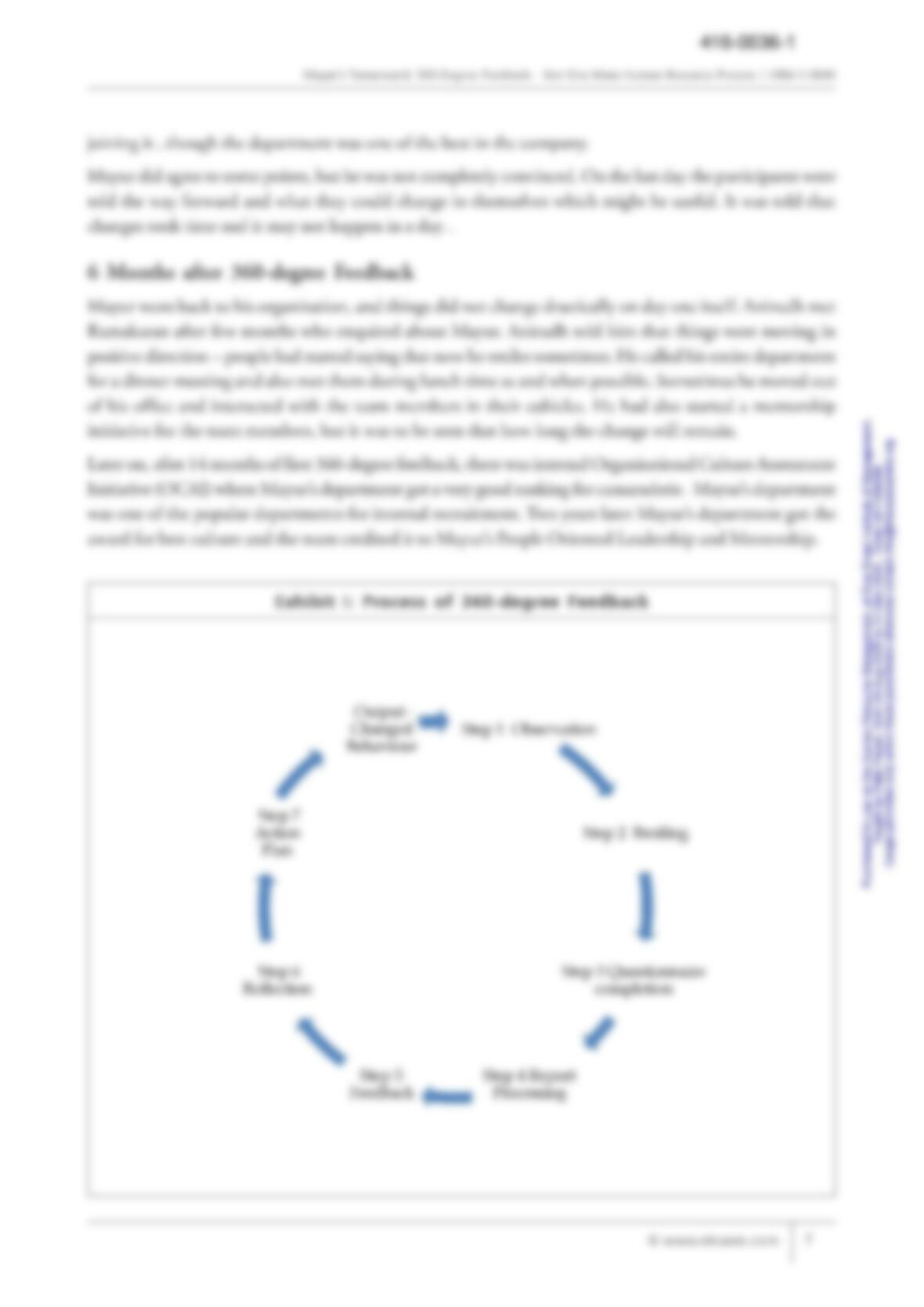
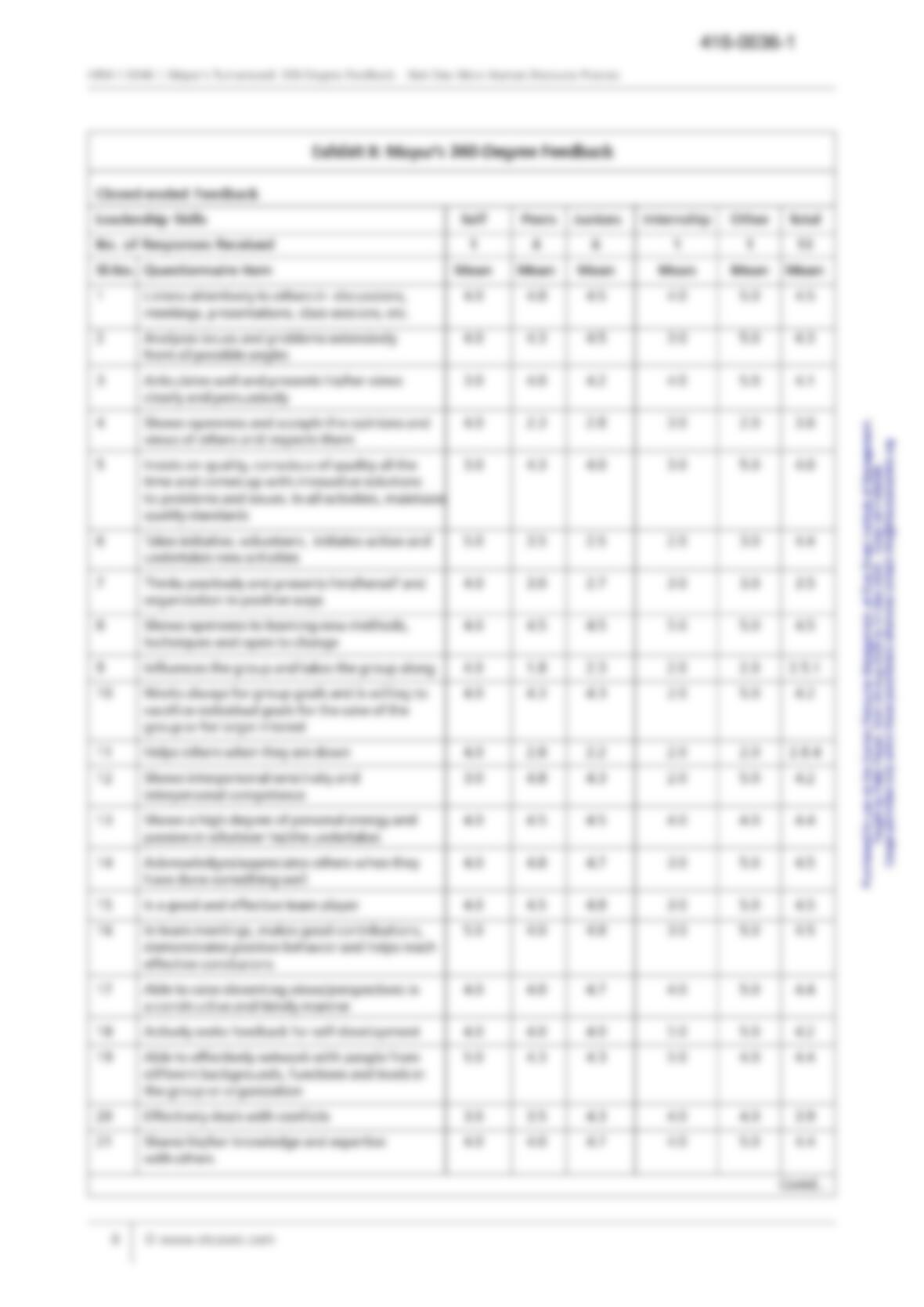
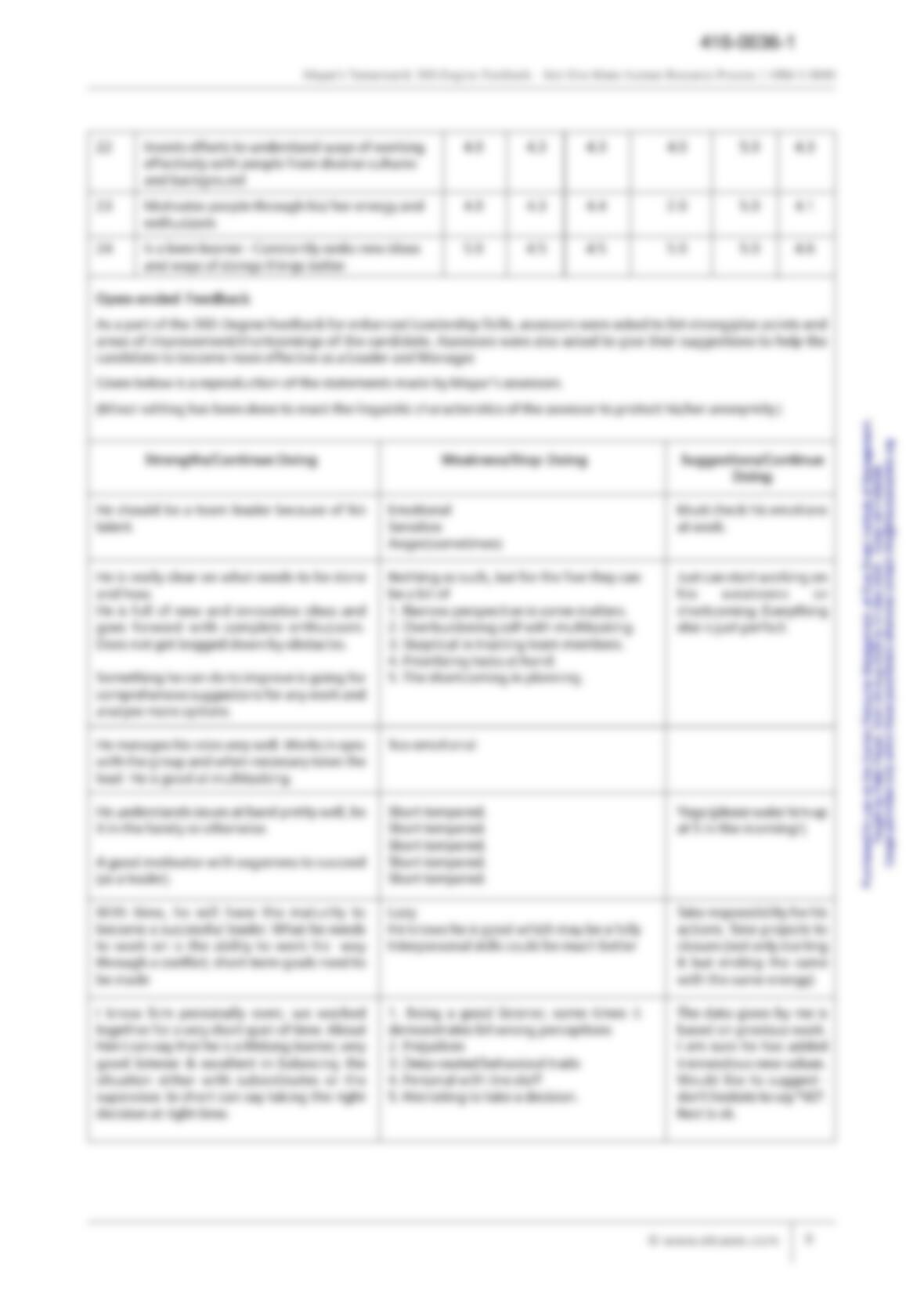
360-Degree Feedback: The Process (Exhibit I)
360-degree feedback is one of the most popular performance appraisal tools these days. It is a tool that is in
operation in all Fortune 500 organizations, generally along with Forced Distribution method. 360-degree
feedback is defined as the “The systematic collection and feedback of performance data on the individual or
group derived from a number of stakeholders in their performance. The technique measures in detail the
behaviors and competencies shown by the individual or group in achieving goals. They, their heads, their
staff, team members, internal/external customers, suppliers, family, and friends can confidentially assess
participants. Raters or Respondents judge what they perceive as behavior, not the intentions behind it. The
feedback data has many uses, including developmental, appraisal, team building, and validation of training,
organization development and remuneration (although less preferred). The technique presents feedback in a
powerful way, and can affect the quantity and quality of performance data, communications and staff
motivation and the roles of those involved. Everyone’s results are a mixture of strengths and areas for
development, some expected and some unexpected. 360-degree feedback however is not a quick process.
There are important stages after feedback has been collected and reported which are essential in changing
behavior. 360-degree feedback has recently become popular because of changes in what organizations expect
of their employees, increased emphasis on performance measurement and change management concepts
416-0036-1