1
Economics 101
Summer 2011
Answers to Homework #2
Due Tuesday, May 31, 2011
Homework is due at the beginning of the lecture. All homework should be neatly and professionally done.
Please make sure that your name is clearly legible and that you show all of your work on your homework.
Please staple your homework before coming to class.
1. Joe and Mary both produce gadgets and widgets. Mary can produce 100 gadgets and 0 widgets, or 0
gadgets and 50 widgets or any combination of gadgets and widgets that lie on the straight line between
these two points. Joe can produce 400 gadgets and 0 widgets, or 200 gadgets and 50 widgets or any
combination of gadgets and widgets that lie on the straight line between these two points. Currently Joe
and Mary are not trading with one another; Joe is producing 200 gadgets and 50 widgets while Mary is
producing 50 gadgets and 25 widgets.
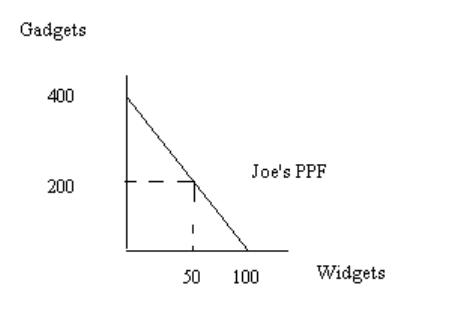
a. Draw Joe’s production possibility frontier for gadgets and widgets on a graph where gadgets are
measured on the y-axis and widgets are measured on the x-axis. Then write an equation for Joe’s PPF
where G is gadgets and W is widgets.
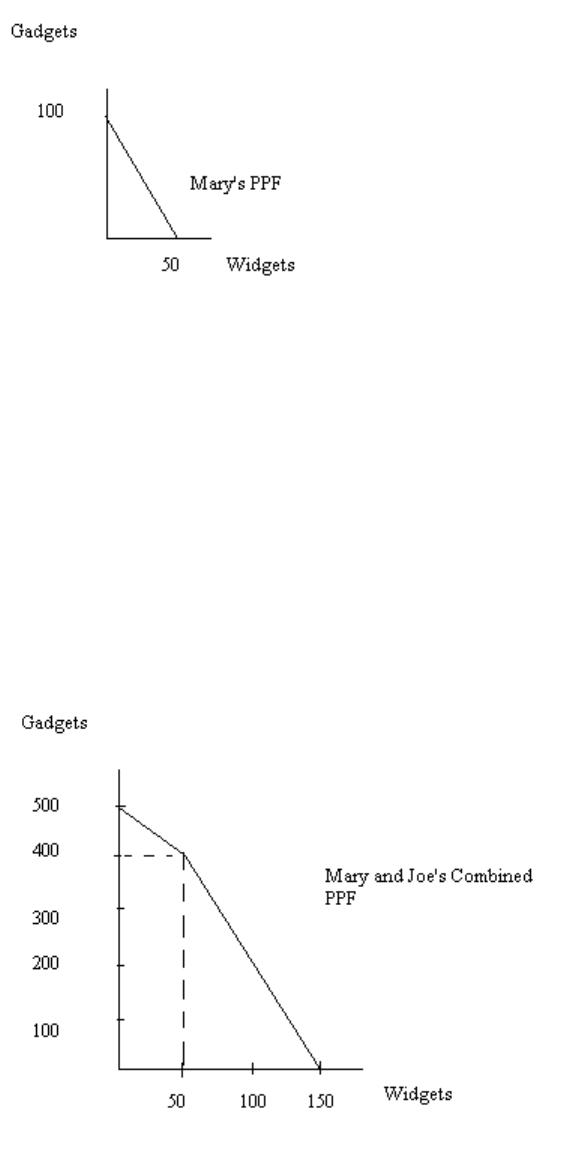
b. Draw Mary’s production possibility frontier for gadgets and widgets on a graph where gadgets are
measured on the y-axis and widgets are measured on the x-axis. Then write an equation for Mary’s PPF
where G is gadgets and W is widgets.
c. Who has the absolute advantage in the production of widgets?
d. Who has the absolute advantage in the production of gadgets?
e. Who has the comparative advantage in the production of widgets?
f. Who has the comparative advantage in the production of gadgets?
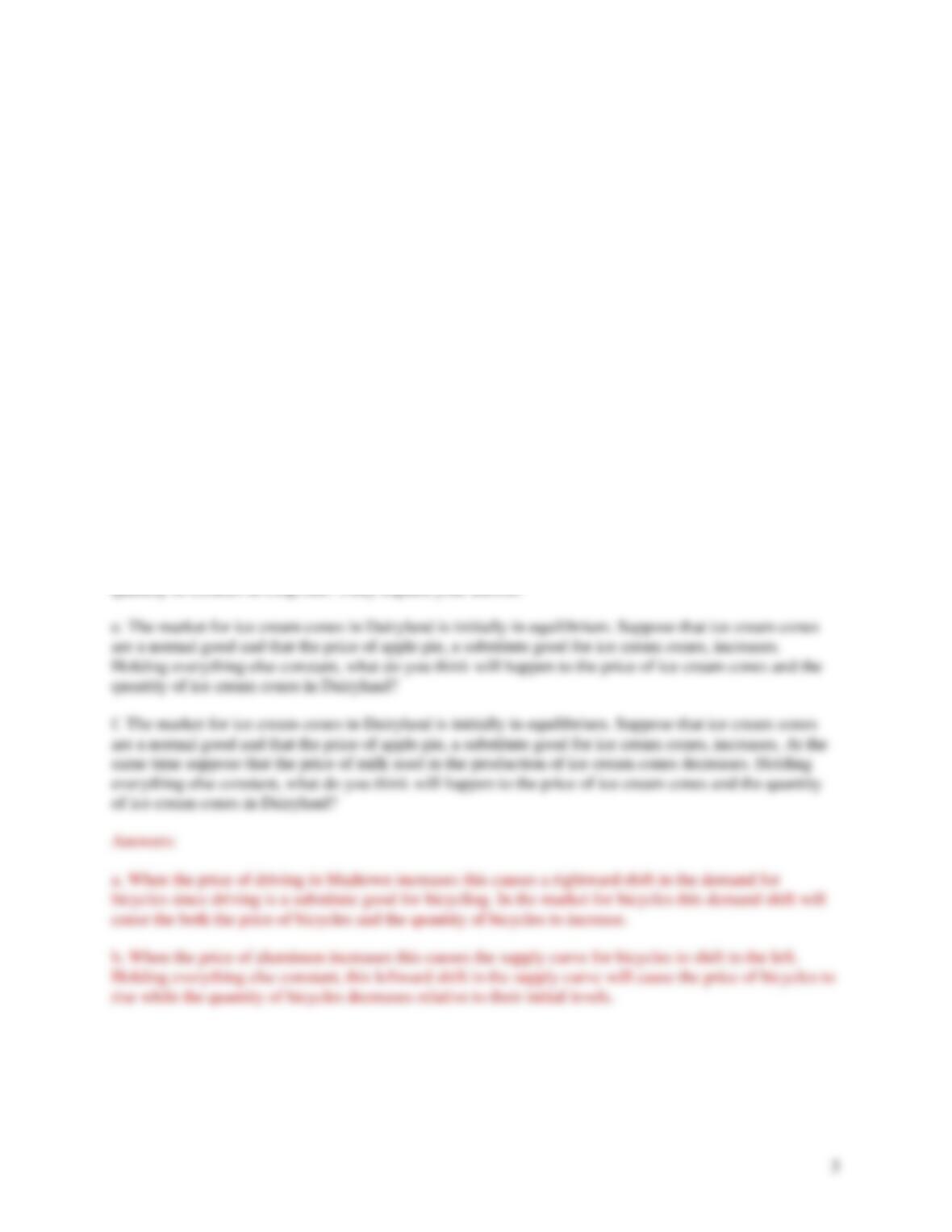
g. If Mary and Joe specialize and trade with one another, what would their combined PPF look like? Draw
a graph of this combined PPF where gadgets are measured on the y-axis and widgets are measured on the
x-axis. Describe verbally how this combined PPF differs from the individual PPFs you drew in parts (a)
and (b).
h. What is a range of trading prices in gadgets that 10 widgets would trade for?
i. What is a range of trading prices in widgets that 5 gadgets would trade for?
Answer:
a.
G = 400 – 4W
b.
2
G = 100 – 2W
c. Joe has the absolute advantage in the production of widgets.
d. Joe has the absolute advantage in the production of gadgets.
e. Mary has the comparative advantage in the production of widgets since her opportunity cost of
producing one widget is 2 gadgets while Joe’s opportunity cost of producing one widget is 4 gadgets.
f. Joe has the comparative advantage in the production of gadgets since his opportunity cost of producing
one gadget is ¼ widget while Mary’s opportunity cost of producing one gadget is ½ widget.
g.
The combined PPF is bowed out away from the origin due to specialization according to comparative
advantage.
h. One widget would trade between 2 gadgets and 4 gadgets, so 10 widgets would trade between 20
gadgets and 40 gadgets.
i. One gadget would trade between ¼ widget and ½ widget, so 5 gadgets would trade between 5/4 widgets
and 5/2 widgets.
2. For each of the following scenarios sketch a diagram representing the scenario and then answer the
given questions.
a. The market for bicycles in Madtown is initially in equilibrium. Then, the city government passes
legislation that increases the costs of driving a car in Madtown. Holding everything else constant, what do
you think will happen to the price of bicycles and the quantity of bicycles in Madtown?
b. The market for bicycles in Madtown is initially in equilibrium. Then, the price of aluminum, an
important input in the production of bicycles, increases. Holding everything else constant, what do you
think will happen to the price of bicycles and the quantity of bicycles in Madtown?
c. The market for bicycles in Madtown is initially in equilibrium. Then, the city government passes
legislation that increases the costs of driving a car in Madtown. At the same time the price of aluminum,
an important input in the production of bicycles, increases. Holding everything else constant, what do you
think will happen to the price of bicycles and the quantity of bicycles in Madtown?
d. The market for cookies in Chipville is initially in equilibrium. Then, people’s income in Chipville
increases. Holding everything else constant, what do you think will happen to the price of cookies and the