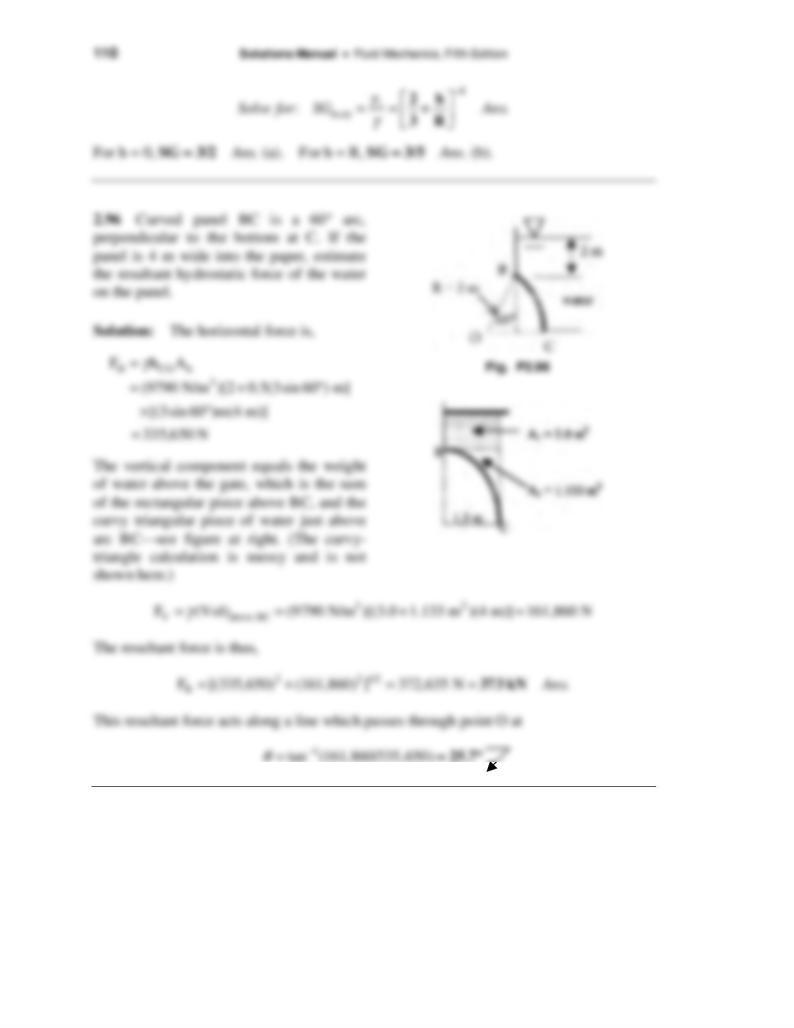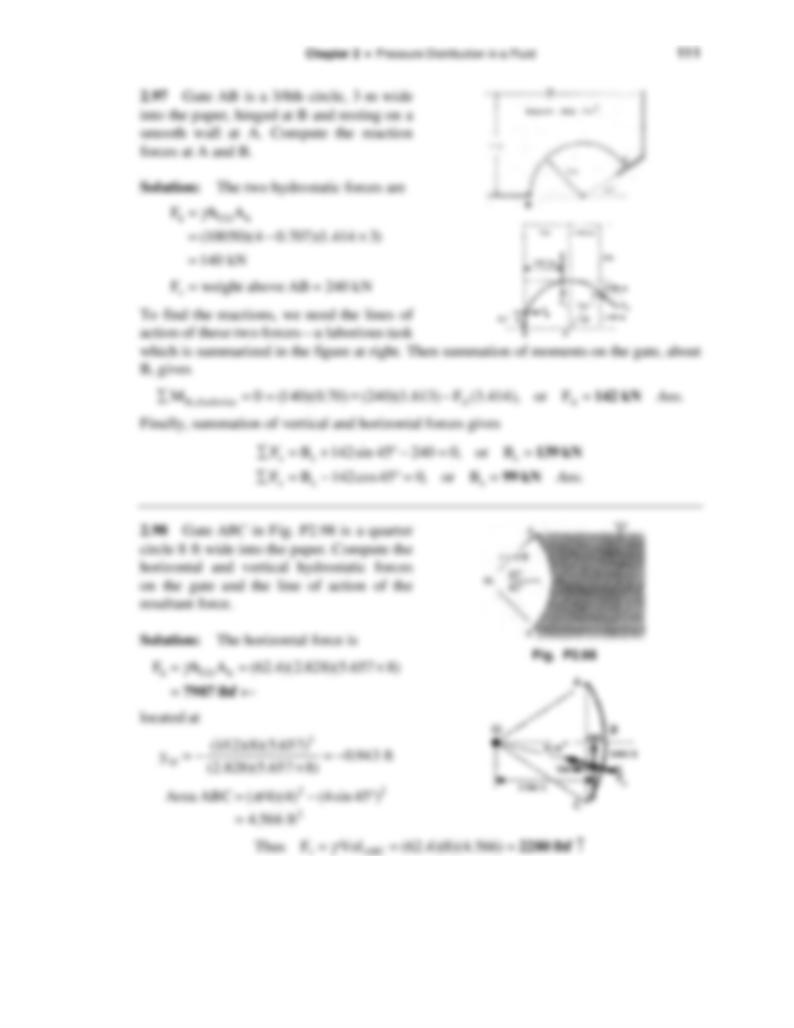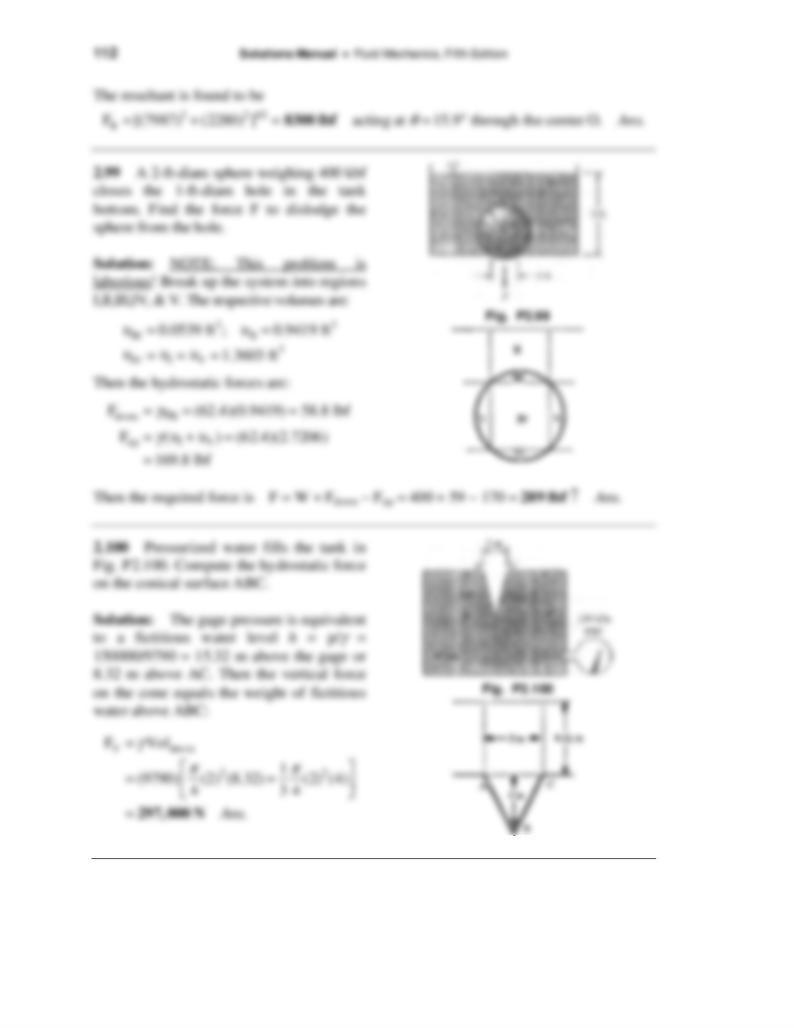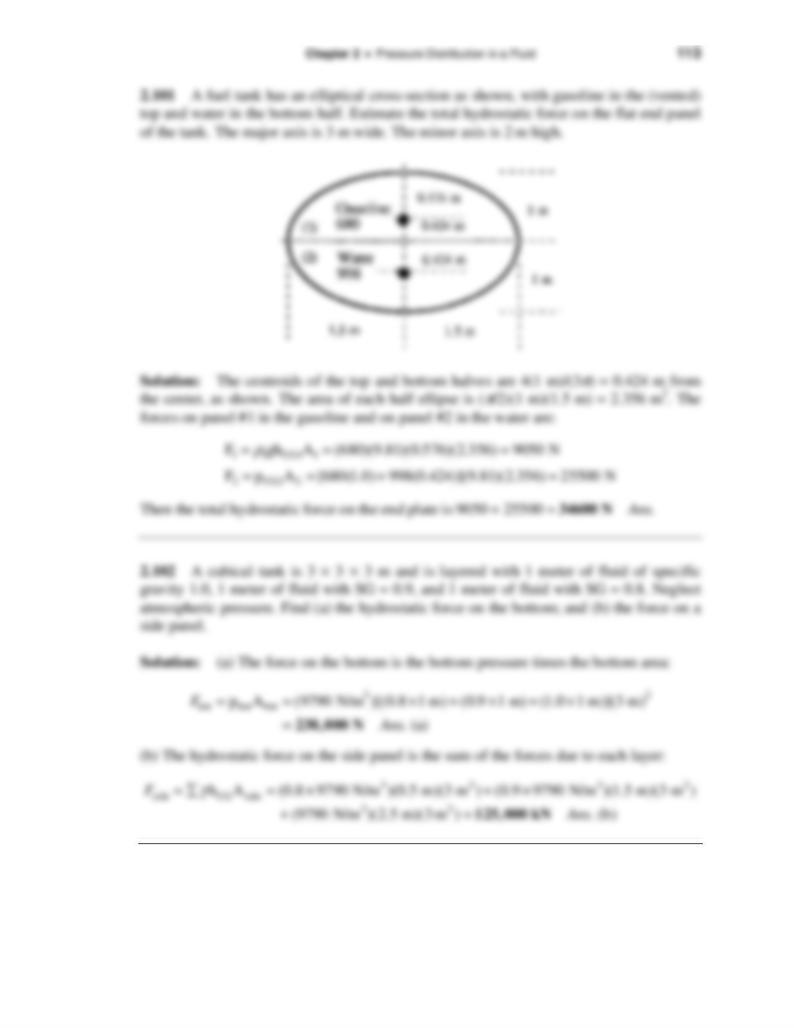
Chapter 1 • Introduction
1.1 A gas at 20°C may be rarefied if it contains less than 1012 molecules per mm3. If
Avogadro’s number is 6.023E23 molecules per mole, what air pressure does this represent?
Solution: The mass of one molecule of air may be computed as
1
Molecular weight 28.97 mol
m 4.81E 23 g
Avogadro’s number 6.023E23 molecules/g mol
−
== =−
⋅
Then the density of air containing 1012 molecules per mm3 is, in SI units,
ρ
æöæ ö
=−
ç÷ç ÷
èøè ø
=− =−
12 3
33
molecules g
10 4.81E 23
molecule
mm
gkg
4.81E 11 4.81E 5
mm m
Finally, from the perfect gas law, Eq. (1.13), at 20°C = 293 K, we obtain the pressure:
ρ
Α
æö
æö
== − =
ç÷
ç÷
⋅
èø
èø
2
32
kg m
p RT 4.81E 5 287 (293 K) .
msK ns4.0 Pa
1.2 The earth’s atmosphere can be modeled as a uniform layer of air of thickness 20 km
and average density 0.6 kg/m3 (see Table A-6). Use these values to estimat e the total mass
and total number of molecules of air in the entire atmosphere of the earth.
Solution: Let Re be the earth’s radius ≈ 6377 km. Then the total mass of air in the
atmosphere is
2
tavgavge
32
m dVol (Air Vol) 4 R (Air thickness)
(0.6 kg/m )4 (6.377E6 m) (20E3 m) .
A
ns
ρρ ρπ
π
== ≈
=≈
ò
6.1E18 kg
Dividing by the mass of one molecule ≈ 4.8E−23 g (see Prob. 1.1 above), we obtain the
total number of molecules in the earth’s atmosphere:
molecules m(atmosphere) 6.1E21 grams
N
m(one molecule) 4.8E 23 gm/molecule
A
ns.== ≈
−1.3E44 molecules
2 Solutions Manual • Fluid Mechanics, Fifth Edition
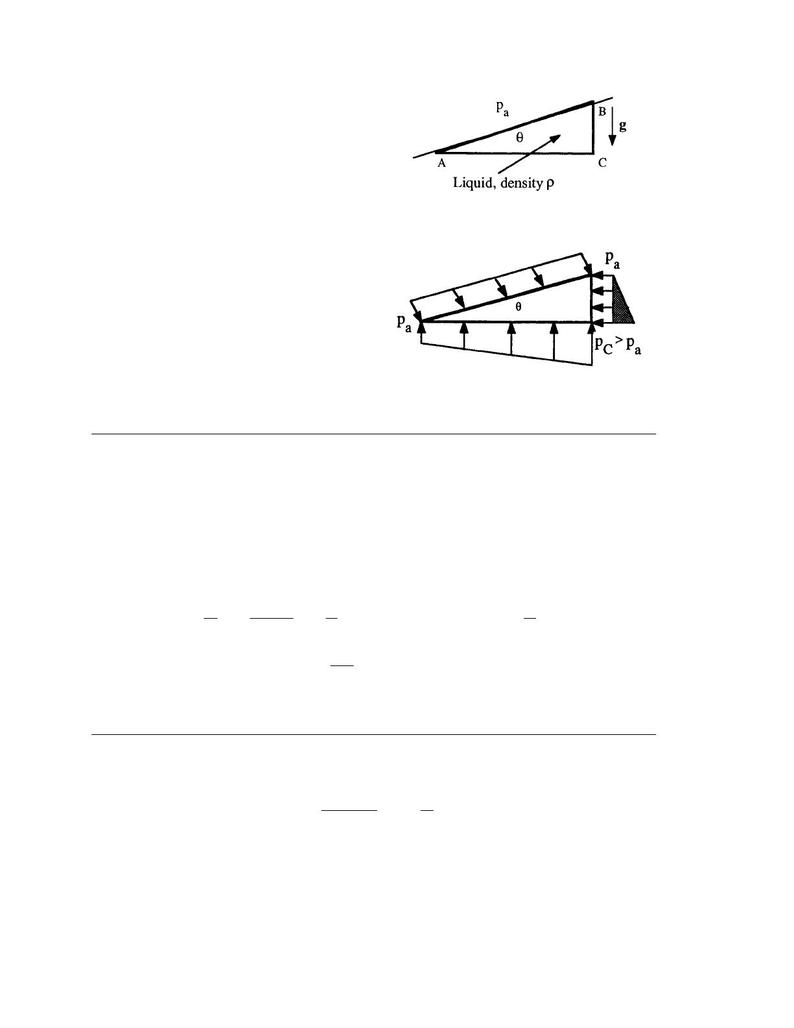
1.3 For the triangular element in Fig. P1.3,
show that a tilted free liquid surface, in
contact with an atmosphere at pressure pa,
must undergo shear stress and hence begin
to flow.
Solution: Assume zero shear. Due to
element weight, the pressure along the
lower and right sides must vary linearly as
shown, to a higher value at point C. Vertical
forces are presumably in balance with ele-
ment weight included. But horizontal forces
are out of balance, with the unbalanced
force being to the left, due to the shaded
excess-pressure triangle on the right side
BC. Thus hydrostatic pressures cannot keep
the element in balance, and shear and flow
result.
Fig. P1.3
1.4 The quantities viscosity
µ
, velocity V, and surface tension Y may be combined into
a dimensionless group. Find the combination which is proportional to
µ
. This group has a
customary name, which begins with C. Can you guess its name?
Solution: The dimensions of these variables are {
µ
} = {M/LT}, {V} = {L/T}, and {Y} =
{M/T2}. We must divide
µ
by Y to cancel mass {M}, then work the velocity into the
group:
2
/, {};
Y/
.
MLT T L
hence multiply by V
LT
MT
finally obtain Ans
µ
ìü
ìü ìü ìü
== =
í ý í ý íý íý
îî î
þþ þ
îþ
µ
Vdimensionless.
Y=
This dimensionless parameter is commonly called the Capillary Number.
1.5 A formula for estimating the mean free path of a perfect gas is:
1.26 1.26 (RT)
p
(RT)
µµ
ρ
==√
√
l (1)

Chapter 1 • Introduction 3
where the latter form follows from the ideal-gas law,
ρ
= p/RT. What are the dimensions
of the constant “1.26”? Estimate the mean free path of air at 20°C and 7 kPa. Is air
rarefied at this condition?
Solution: We know the dimensions of every term except “1.26”:
2
32
MM L
{} {L} { } { } {R} {T} { }
LT LT
µρ
ìü
ìü ìü
== = = =Θ
íý íý í ý
Θ
îþ îþ îþ
l
Therefore the above formula (first form) may be written dimensionally as
322
{M/L T}
{L} {1.26?} {1.26?}{L}
{M/L } [{L /T }{ }]
⋅
==
√⋅ΘΘ
Since we have {L} on both sides, {1.26} = {unity}, that is, the constant is dimensionless.
The formula is therefore dimensionally homogeneous and should hold for any unit system.
For air at 20°C = 293 K and 7000 Pa, the density is
ρ
= p/RT = (7000)/[(287)(293)] =
0.0832 kg/m3. From Table A-2, its viscosity is 1.80E−5 N ⋅ s/m2. Then the formula predict
a mean free path of
1/2
1.80E 5
1.26 (0.0832)[(287)(293)]
A
ns.
−
=≈
l9.4E 7 m−
This is quite small. We would judge this gas to approximate a continuum if the physical
scales in the flow are greater than about 100 ,
l that is, greater than about 94
µ
m.
1.6 If p is pressure and y is a coordinate, state, in the {MLT} system, the dimensions of
the quantities (a)
∂
p/
∂
y; (b) ò p dy; (c)
∂
2p/
∂
y2; (d) ∇p.
Solution: (a) {ML−2T−2}; (b) {MT−2}; (c) {ML−3T−2}; (d) {ML−2T−2}
1.7 A small village draws 1.5 acre-foot of water per day from its reservoir. Convert this
water usage into (a) gallons per minute; and (b) liters per second.
Solution: One acre = (1 mi2/640) = (5280 ft)2/640 = 43560 ft2. Therefore 1.5 acre-ft =
65340 ft3 = 1850 m3. Meanwhile, 1 gallon = 231 in3 = 231/1728 ft3. Then 1.5 acre-ft of
water per day is equivalent to
3
3
ft 1728 gal 1 day
Q 65340 . (a)
day 231 1440 min
ft Ans
æöæ ö
=≈
ç÷ç ÷
èøè ø
gal
340 min

4 Solutions Manual • Fluid Mechanics, Fifth Edition
Similarly, 1850 m3 = 1.85E6 liters. Then a metric unit for this water usage is:
L1day
Q 1.85E6 . (b)
day 86400 sec Ans
æö
æö
=≈
ç÷
ç÷
èø
èø
L
21 s
1.8 Suppose that bending stress
σ
in a beam depends upon bending moment M and
beam area moment of inertia I and is proportional to the beam half-thickness y. Suppose
als o tha t, for the particular case M = 2900 in⋅lbf, y = 1.5 in, and I = 0.4 in4, the predicted
stress is 75 MPa. Find the only possible dimensionally homogeneous formula for
σ
.
Solution: We are given that
σ
= y fcn(M,I) and we are not to study up on strength of
materials but only to use dimensional reasoning. For homogeneity, the right hand side
must have dimensions of stress, that is,
2
M
{ } {y}{fcn(M,I)}, or: {L}{fcn(M,I)}
LT
σ
ìü
==
íý
îþ
or: the function must have dimensions 22
M
{fcn(M,I)} LT
ìü
=íý
îþ
Therefore, to achieve dimensional homogeneity, we somehow must combine bending
moment, whose dimensions are {ML2T–2}, with area moment of inertia, {I} = {L4}, and
end up with {ML–2T–2}. Well, it is clear that {I} contains neither mass {M} nor time {T}
dimensions, but the bending moment contains both mass and time and in exactly the com-
bination we need, {MT –2}. Thus it must be that
σ
is proportional to M also. Now we
have reduced the problem to:
2
22
MML
yM fcn(I), or {L} {fcn(I )}, or: {fcn(I)}
LT T
σ
ìü
ìü
== =
íý í ý
îþ îþ
4
{L }
−
We need just enough I’s to give dimensions of {L–4}: we need the formula to be exactly
inverse in I. The correct dimensionally homogeneous beam bending formula is thus:
where {C} {unity} .
A
ns=
σ
=My
C,
I
The formula admits to an arbitrary dimensionless constant C whose value can only be
obtained from known data. Convert stress into English units:
σ
= (75 MPa)/(6894.8) =
10880 lbf/in2. Substitute the given data into the proposed formula:
24
lbf My (2900 lbf in)(1.5 in)
10880 C C , or:
I
in 0.4 in
A
ns.
σ
⋅
=== C1.00≈
The data show that C = 1, or
σ
= My/I, our old friend from strength of materials.

Chapter 1 • Introduction 5
1.9 The dimensionless Galileo number, Ga, expresses the ratio of gravitational effect to
viscous effects in a flow. It combines the quantities density
ρ
, acceleration of gravity g,
length scale L, and viscosity
µ
. Without peeking into another textbook, find the form of
the Galileo number if it contains g in the numerator.
Solution: The dimensions of these variables are {
ρ
} = {M/L3}, {g} = {L/T2}, {L} =
{L}, and {
µ
} = {M/LT}. Divide
ρ
by
µ
to eliminate mass {M} and then combine with g
and L to eliminate length {L} and time {T}, making sure that g appears only to the first
power:
3
2
/
/
ML T
MLT L
ρ
µ
ìü
ìü ìü
==
íýí ýí ý
îþ
îþîþ
while only {g} contains {T}. To keep {g} to the 1st power, we need to multiply it by
{
ρ
/
µ
}2. Thus {
ρ
/
µ
}2{g} = {T2/L4}{L/T2} = {L−3}.
We then make the combination dimensionless by multiplying the group by L3. Thus
we obtain:
ρρ
µµ
æö
== = =
ç÷
èø
223
32
()() .
gL
Galileo number Ga g L Ans
3
2
gL
ν
1.10 The Stokes-Oseen formula [10] for drag on a sphere at low velocity V is:
22
9
F3 DV VD
16
π
πµ ρ
=+
where D = sphere diameter,
µ
= viscosity, and
ρ
= density. Is the formula homogeneous?
Solution: Write this formula in dimensional form, using Table 1-2:
22
9
{F} {3 }{ }{D}{V} { }{V} {D} ?
16
π
πµ ρ
ìü
=+
íý
îþ
22
232
ML M L M L
or: {1} {L} {1} {L } ?
LT T
TLT
ìü
ìü ìüìü ìü
=+
íý íýíý íýíý
îþ îþîþ îþ
îþ
where, hoping for homogeneity, we have assumed that all constants (3,
π
,9,16) are pure,
i.e., {unity}. Well, yes indeed, all terms have dimensions {ML/T2}! Therefore the Stokes-
Oseen formula (derived in fact from a theory) is dimensionally homogeneous.