1
1
PART 1 Overview of Corporate Finance
INTRODUCTION TO
CORPORATE FINANCE
To begin our study of modern corporate nance and nancial management, we need to
address two central issues. First, what is corporate nance and what is the role of the –
nancial manager in the corporation? Second, what is the goal of nancial management? To
describe the nancial management environment, we consider the corporate form of organi-
zation and discuss some con icts that can arise within the corporation. We also take a brief
look at nancial markets in the United States.
COMPENSATION OF CORPORATE EXECUTIVES in the United States continues to be a hot button
issue. It is widely viewed that CEO pay has grown to exorbitant levels (at least in some cases). In response, in July
2010, the Dodd–Frank Wall Street Reform and Consumer Protection Act became law. The “say-on-pay” portion of
the bill requires that, beginning in January 2011, corporations with a market value over $75 million allow a nonbind-
ing shareholder vote on executive pay. (Note that because the bill applies to corporations, it does not give voters a
say on pay for U.S. representatives and senators.)
Specifi cally, the measure allows shareholders to approve or disapprove a company’s executive compensation plans.
Because the bill is nonbinding, it does not permit shareholders to veto a compensation package and does not place limits
on executive pay. In February 2011, the shareholders of Beazer Homes USA and Jacobs Engineering Group became
the fi rst shareholders to vote against executive compensation under the new law. One analyst expected that these two
companies would not be alone, as he expected at least 50 companies to receive negative votes during 2011.
Understanding how a corporation sets executive pay, and the role of shareholders in that process, takes us into
issues involving the corporate form of organization, corporate goals, and corporate control, all of which we cover
in this chapter.
LEARNING OBJECTIVES
After studying this chapter, you
should understand:
LO1 The basic types of nancial
management decisions
and the role of the nancial
manager.
LO2 The goal of nancial
management.
LO3 The nancial implications of
the different forms of business
organization.
LO4 The con icts of interest that
can arise between managers
and owners.
ros79459_ch01_001-019.indd 1ros79459_ch01_001-019.indd 1 06/12/11 4:37 PM06/12/11 4:37 PM

2 PART 1 Overview of Corporate Finance
Corporate Finance and
the Financial Manager
In this section, we discuss where the nancial manager ts in the corporation. We start by
de ning corporate nance and the nancial manager’s job.
WHAT IS CORPORATE FINANCE?
Imagine that you were to start your own business. No matter what type you started, you
would have to answer the following three questions in some form or another:
1. What long-term investments should you take on? That is, what lines of business will
you be in and what sorts of buildings, machinery, and equipment will you need?
2. Where will you get the long-term nancing to pay for your investment? Will you bring
in other owners or will you borrow the money?
3. How will you manage your everyday nancial activities such as collecting from cus-
tomers and paying suppliers?
These are not the only questions by any means, but they are among the most important.
Corporate nance, broadly speaking, is the study of ways to answer these three questions.
Accordingly, we’ll be looking at each of them in the chapters ahead.
THE FINANCIAL MANAGER
A striking feature of large corporations is that the owners (the stockholders) are usually not
directly involved in making business decisions, particularly on a day-to-day basis. Instead,
the corporation employs managers to represent the owners’ interests and make decisions on
their behalf. In a large corporation, the nancial manager would be in charge of answering
the three questions we raised in the preceding section.
T h e nancial management function is usually associated with a top of cer of the rm, such
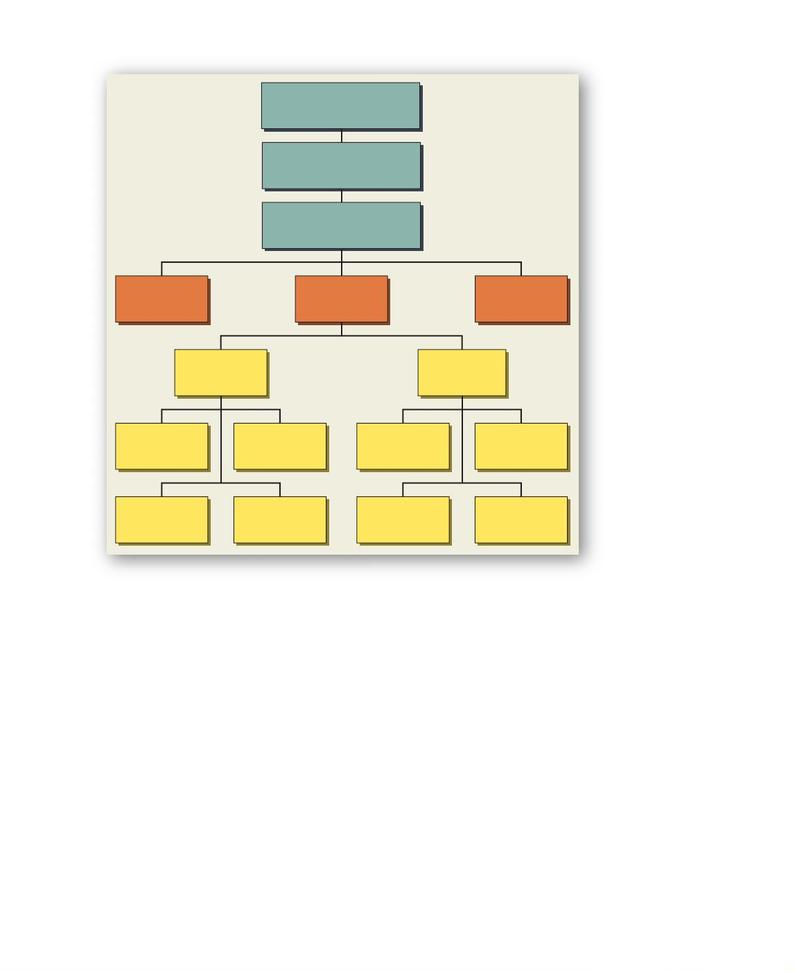
as a vice president of nance or some other chief nancial of cer (CFO). Figure 1.1 is a sim–
pli ed organizational chart that highlights the nance activity in a large rm. As shown, the
vice president of nance coordinates the activities of the treasurer and the controller. The con-
troller’s of ce handles cost and nancial accounting, tax payments, and management infor–
mation systems. The treasurer’s of ce is responsible for managing the rm’s cash and credit,
its nancial planning, and its capital expenditures. These treasury activities are all related to
the three general questions raised earlier, and the chapters ahead deal primarily with these is-
sues. Our study thus bears mostly on activities usually associated with the treasurer’s of ce.
FINANCIAL MANAGEMENT DECISIONS
As the preceding discussion suggests, the nancial manager must be concerned with three
basic types of questions. We consider these in greater detail next.
Capital Budgeting The rst question concerns the rm’s long-term investments. The pro-
cess of planning and managing a rm’s long-term investments is called capital budgeting .
In capital budgeting, the nancial manager tries to identify investment opportunities that
are worth more to the rm than they cost to acquire. Loosely speaking, this means that the
value of the cash ow generated by an asset exceeds the cost of that asset.
The types of investment opportunities that would typically be considered depend in
part on the nature of the rm’s business. For example, for a large retailer such as Walmart,
1.1
Check out the companion
website for this text at
www.mhhe.com/rwj .
For current issues facing
CFOs, see www.cfo.com .
capital budgeting
The process of planning
and managing a fi rm’s long-
term investments.
ros79459_ch01_001-019.indd 2ros79459_ch01_001-019.indd 2 06/12/11 4:37 PM06/12/11 4:37 PM
Chapter 1 Introduction to Corporate Finance 3
deciding whether to open another store would be an important capital budgeting decision.
Similarly, for a software company such as Oracle or Microsoft, the decision to develop and
market a new spreadsheet program would be a major capital budgeting decision. Some
decisions, such as what type of computer system to purchase, might not depend so much
on a particular line of business.
R e g a r d l e s s o f t h e s p e c i c nature of an opportunity under consideration, nancial man-
agers must be concerned not only with how much cash they expect to receive, but also with
when they expect to receive it and how likely they are to receive it. Evaluating the size,
timing, a n d risk of future cash ows is the essence of capital budgeting. In fact, as we will
see in the chapters ahead, whenever we evaluate a business decision, the size, timing, and
risk of the cash ows will be by far the most important things we will consider.
Capital Structure The second question for the nancial manager concerns ways in
which the rm obtains and manages the long-term nancing it needs to support its long-
term investments. A rm’s capital structure (or nancial structure) is the speci c mixture
of long-term debt and equity the rm uses to nance its operations. The nancial manager
has two concerns in this area. First, how much should the rm borrow? That is, what mix-
ture of debt and equity is best? The mixture chosen will affect both the risk and the value of
the rm. Second, what are the least expensive sources of funds for the rm?
capital structure
The mixture of debt and
equity maintained by a fi rm.
FIGURE 1.1
A Sample Simplifi ed
Organizational Chart
Chairman of the board and
chief executive officer
(CEO)
Board of directors
President and chief
operations officer (COO)
Tax manager
Financial
accounting
manager
Controller
Cash manager
Treasurer
Vice president
marketing
Vice president
finance (CFO)
Vice
president
production
Capital
expenditures
Credit manager
Financial
planning
Cost
accounting
manager
Data
processing
manager
ros79459_ch01_001-019.indd 3ros79459_ch01_001-019.indd 3 06/12/11 4:37 PM06/12/11 4:37 PM

4 PART 1 Overview of Corporate Finance
If we picture the rm as a pie, then the rm’s capital structure determines how that pie is
sliced—in other words, what percentage of the rm’s cash ow goes to creditors and what
percentage goes to shareholders. Firms have a great deal of exibility in choosing a nan-
cial structure. The question of whether one structure is better than any other for a particular
rm is the heart of the capital structure issue.
In addition to deciding on the nancing mix, the nancial manager has to decide ex-
actly how and where to raise the money. The expenses associated with raising long-term
nancing can be considerable, so different possibilities must be carefully evaluated. Also,
corporations borrow money from a variety of lenders in a number of different, and some-
times exotic, ways. Choosing among lenders and among loan types is another job handled
by the nancial manager.
Working Capital Management The third question concerns working capital manage-
ment. The term working capital refers to a rm’s short-term assets, such as inventory, and
its short-term liabilities, such as money owed to suppliers. Managing the rm’s working
capital is a day-to-day activity that ensures that the rm has suf cient resources to continue
its operations and avoid costly interruptions. This involves a number of activities related to
the rm’s receipt and disbursement of cash.
Some questions about working capital that must be answered are the following: (1) How
much cash and inventory should we keep on hand? (2) Should we sell on credit? If so, what
terms will we offer, and to whom will we extend them? (3) How will we obtain any needed
short-term nancing? Will we purchase on credit, or will we borrow in the short term and
pay cash? If we borrow in the short term, how and where should we do it? These are just a
small sample of the issues that arise in managing a rm’s working capital.
Conclusion The three areas of corporate nancial management we have described—
capital budgeting, capital structure, and working capital management—are very broad cat-
egories. Each includes a rich variety of topics, and we have indicated only a few questions
that arise in the different areas. The chapters ahead contain greater detail.
working capital
A fi rm’s short-term assets
and liabilities.
1.1a What is the capital budgeting decision?
1.1b What do you call the speci c mixture of long-term debt and equity that a rm
chooses to use?
1.1c Into what category of nancial management does cash management fall?
Concept Questions
Forms of Business Organization
Large rms in the United States, such as Ford and Microsoft, are almost all organized as
corporations. We examine the three different legal forms of business organization—sole
proprietorship, partnership, and corporation—to see why this is so. Each form has distinct
advantages and disadvantages for the life of the business, the ability of the business to raise
cash, and taxes. A key observation is that as a rm grows, the advantages of the corporate
form may come to outweigh the disadvantages.
SOLE PROPRIETORSHIP
A sole proprietorship is a business owned by one person. This is the simplest type of
business to start and is the least regulated form of organization. Depending on where you
1.2
sole proprietorship
A business owned by a
single individual.
ros79459_ch01_001-019.indd 4ros79459_ch01_001-019.indd 4 06/12/11 4:37 PM06/12/11 4:37 PM