For Property
Student Workbook
Version 1.0
This page is intentionally left blank.

Financial Concepts For Property
Last Revised: 18 February 2014 Ver 1.0
Page iii
Table of Contents
INTRODUCTION TO THE WORKBOOK ………………………………………………………………………………………………… 5
KEY TERMS …………………………………………………………………………………………………………………………………………. 6
RESOURCES AND REFERENCES …………………………………………………………………………………………………………………… 9
Mathematics References ………………………………………………………………………………………………………………. 9
Valuation References ……………………………………………………………………………………………………………………. 9
Required Resources ………………………………………………………………………………………………………………………. 9
TOPIC 1: CAPITALISATION PRINCIPLES ……………………………………………………………………………………………..10
INTRODUCTION ………………………………………………………………………………………………………………………………….. 10
Learning Outcomes …………………………………………………………………………………………………………………….. 10
CAPITALISATION AND YEARS PURCHASE ……………………………………………………………………………………………………… 10
Capitalisation Rate ……………………………………………………………………………………………………………………… 11
Years Purchase …………………………………………………………………………………………………………………………… 12
Reciprocal Relationship ……………………………………………………………………………………………………………….. 12
RENT DETERMINATION …………………………………………………………………………………………………………………………. 14
Rental Surveys ……………………………………………………………………………………………………………………………. 14
REVIEW OF OUTGOINGS ………………………………………………………………………………………………………………………… 15
Factors Affecting Expenses ………………………………………………………………………………………………………….. 16
ANALYSIS AND SELECTION OF CAPITALISATION RATES………………………………………………………………………………………. 17
COMPARABLE SALES …………………………………………………………………………………………………………………………….. 18
Elements of Sales ……………………………………………………………………………………………………………………….. 18
STEPS IN THE CAPITALISATION METHOD ……………………………………………………………………………………………………… 19
ANALYSIS OF RISK ……………………………………………………………………………………………………………………………….. 20
SUMMARY ………………………………………………………………………………………………………………………………………… 21
TOPIC 2: TIME VALUE OF MONEY CALCULATIONS ………………………………………………………………………………22
INTRODUCTION ………………………………………………………………………………………………………………………………….. 22
Learning Outcomes …………………………………………………………………………………………………………………….. 22
THE EFFECT OF TIME ON THE VALUE OF MONEY ……………………………………………………………………………………………. 23
SIMPLE AND COMPOUND INTEREST …………………………………………………………………………………………………………… 24
Simple Interest …………………………………………………………………………………………………………………………… 24
Compound Interest …………………………………………………………………………………………………………………….. 25
ELEMENTS OF TVM PROBLEMS AND CASH FLOW DIAGRAM ……………………………………………………………………………… 26
METHODS OF CALCULATION AND TOOLS …………………………………………………………………………………………………….. 28
THE SHARP BUSINESS/FINANCIAL CALCULATOR …………………………………………………………………………………………….. 29
FUTURE AND PRESENT VALUE CALCULATIONS……………………………………………………………………………………………….. 31
Future Value ………………………………………………………………………………………………………………………………. 31
Future Value where interest is not paid annually ……………………………………………………………………………. 34
Present Value …………………………………………………………………………………………………………………………….. 36
Present Value where interest is not paid annually …………………………………………………………………………… 39
Future Value of an Annuity ………………………………………………………………………………………………………….. 40
Present Value of an Annuity …………………………………………………………………………………………………………. 44
Using Present Value of Annuities ………………………………………………………………………………………………….. 48
Sinking Funds …………………………………………………………………………………………………………………………….. 49
Nominal and Effective interest rates ……………………………………………………………………………………………… 51
SUMMARY ………………………………………………………………………………………………………………………………………… 55

Financial Concepts For Property
Page iv
Last Revised 18 February 2014 Ver 1.0
TOPIC 3: DUAL RATE APPLICATIONS ……………………………………………………………………………………………….. 56
INTRODUCTION …………………………………………………………………………………………………………………………………… 56
Learning Outcomes …………………………………………………………………………………………………………………….. 56
LINK BETWEEN PV OF $1 PER ANNUM AND CAPITALISATION………………………………………………………………………………. 56
PRESENT VALUE OF ANNUITIES ………………………………………………………………………………………………………………... 59
DUAL RATE FACTOR …………………………………………………………………………………………………………………………….. 60
APPLICATION OF DUAL RATE FACTORS ……………………………………………………………………………………………………….. 63
SUMMARY ………………………………………………………………………………………………………………………………………… 67
TOPIC 4: VALUATION OF LEASEHOLD INTERESTS ………………………………………………………………………………. 68
INTRODUCTION …………………………………………………………………………………………………………………………………… 68
Learning Outcomes …………………………………………………………………………………………………………………….. 68
LEASEHOLD INTERESTS ………………………………………………………………………………………………………………………….. 69
Lessee’s Interest …………………………………………………………………………………………………………………………. 69
Lessor’s Interest ………………………………………………………………………………………………………………………….. 69
Shortfall/Bonus Method ………………………………………………………………………………………………………………. 70
Term and Reversion Method ………………………………………………………………………………………………………… 73
INCENTIVES AND PREMIUMS …………………………………………………………………………………………………………………… 77
Premiums ………………………………………………………………………………………………………………………………….. 77
Incentives ………………………………………………………………………………………………………………………………….. 78
DEFERRED PAYMENTS …………………………………………………………………………………………………………………………… 81
SUMMARY ………………………………………………………………………………………………………………………………………… 82
TOPIC 5: DISCOUNTED CASH FLOWS ……………………………………………………………………………………………….. 83
INTRODUCTION …………………………………………………………………………………………………………………………………… 83
Learning Outcomes …………………………………………………………………………………………………………………….. 83
DISCOUNTED CASH FLOW ANALYSIS ………………………………………………………………………………………………………….. 84
NET PRESENT VALUE ……………………………………………………………………………………………………………………………. 84
Discount Rate …………………………………………………………………………………………………………………………….. 85
NPV AND VIABILITY……………………………………………………………………………………………………………………………… 89
NPV AND CAPITALISATION …………………………………………………………………………………………………………………….. 91
CHECKING NPV ………………………………………………………………………………………………………………………………….. 94
Examples of NPV where cash flows are not annual …………………………………………………………………………. 96
INTERNAL RATE OF RETURN ……………………………………………………………………………………………………………………. 98
CHECKING IRR …………………………………………………………………………………………………………………………………. 100
IRR AND VIABILITY …………………………………………………………………………………………………………………………….. 101
ADVANTAGES AND DISADVANTAGES OF DCF ………………………………………………………………………………………………. 103
SUMMARY ………………………………………………………………………………………………………………………………………. 105
WORKBOOK EXERCISE SOLUTIONS ………………………………………………………………………………………………… 106

Financial Concepts For Property
s:\userdata\documents\advanced valuation\financial analysis 16634\financial concepts
for property.docx
Page 5 of 126
INTRODUCTION TO THE WORKBOOK
Welcome to Financial Concepts for Property also referred to as Financial Theory in
some texts. You will often need to calculate mathematical problems involving the
time value of money (TVM) in the valuation of property and interests in property. TVM
calculations are needed in many situations including:
• calculation of future values (for example, in some strata insurance valuations)
• calculation of present values (for example, in some development valuations)
• calculations involving dual rates of interest
• valuation of leasehold interest
• valuation of property affected by leasehold interests
• problems involving discounted cash flow analysis
• calculating net present value and internal rate of return
In this workbook you will be introduced to the main TVM calculations that are
applicable to property. It takes you through the calculation of:
• future value
• present value
• future value of an annuity
• present value of an annuity
• sinking funds
You will use a financial calculator and derived formulae to solve a number of practical
examples relating to property as you learn to master these functions. Once you have
finished the basic time value of money functions relating to property, you will learn
how to apply discounted cash flow approaches to property problems and calculate
the important measures of internal rate of return (IRR) and net present value (NPV).
This workbook incorporates detailed instructions for financial calculations using the
Sharp EL–738 calculator, which is ideally suited to financial calculations for property
problems. It would be useful to acquire one so you can follow the procedures.
This workbook will support you in developing the following skills:
• demonstrate financial analysis skills
• prepare financial calculations using a handheld calculator.

Financial Concepts For Property
Page 6 of 126
Last Revised 18 February 2014 Ver 1.0
Key Terms
amortisation the liquidation of an amount of money due in the future by
periodic payments into a sinking fund
annuity a regular payment (or PMT)
begin mode (BGN) a calculation mode allowing for a payment received at the
beginning of a period (month or year)
capitalisation rate a rate of return expressed as a percentage for property; it is
found by dividing the net rent for property by the sales price; it
is used in valuation by dividing the net rent received by the
appropriate capitalisation rate to produce an estimate of value
in the capitalisation method of valuation; the capitalisation rate
is the ‘yield’ for property
cash flow diagram a diagram setting out the positive and negative income flows
from an investment
cash flow scenario a scenario which sets out the net cash flows for a property
problem over a stipulated period; usually done on a
spreadsheet
compound interest interest levied on the outstanding balance of a transaction
rather than on the opening balance
dual rates factors which take account of the present value of a series of
payments through the use of a remunerative rate (an earnings
rate) and a sinking fund rate; the sinking fund rate is usually
less that the remunerative rate (thus allowing for the effect of
taxation)
effective rate of interest the true rate of interest derived from a transaction involving
compound interest rather than the nominal or face rate of
interest
effective rent the true rent after allowing for the present and future values of
any costs, benefits or incentives attached to the lease
arrangement
end mode (END) a financial calculation mode that caters for payments being
received at the end of a period (a month or a year)
equivalent rent the periodic payment that takes account of both the rent being
paid and the periodic value of any single payments such as
rent incentives or premiums
equivalent yield the true yield obtained from a property transaction where rent
payments fluctuate

Financial Concepts For Property
s:\userdata\documents\advanced valuation\financial analysis 16634\financial concepts
for property.docx
Page 7 of 126
escalation the regular increase of a base rent; escalation can be based
on things like fixed increases, the consumer price index or on
increases in turnover
face rent the rent shown on a lease which may not include outgoings or
the effect of any premiums or incentives
future value (FV) the future value of a single (present value) amount or a series
of payments (PMTs)
incentive commonly an inducement, monetary or otherwise, (such as a
free fit–out or rent free period) given to attract a tenant to
premises that are for lease
interest (i) the return or yield on principal—this is an essential part of the
time value of money (TVM) calculation
internal rate of return
(IRR) the true yield derived from a series of unequal cash flows;
usually calculated via spreadsheet or financial calculator
market rent the amount of rental income that could be expected from a
property if available for rent on the open market; the rental
income level indicated by open market rental rates achieved
for comparable space
net present value (NPV) the present value of a series of payments (often unequal
payments) at a given rate of interest and period)
net rent the rent that is net to the owner (lessor) after payment of all
outgoings
nominal rate of interest the stated (face) annual rate of interest, for example a loan at
5.75% annually with principal and interest paid monthly
outgoings the costs (including statutory outgoings and operating costs)
associated with owning a building that is tenanted; statutory
outgoings include rates and land tax; operating costs include
things like maintenance of the property, insurance and
property management
passing rent the current rental being paid by the tenant as specified by the
lease terms
payment (PMT) a regular payment in a financial transaction—it can be both
positive and negative
period (n) one of the essential elements in a time value of money (TVM)
calculation; the number of compounding periods (usually years
or months)
premium in this topic, it is a present value sum paid in respect of the
occupation of premises

Financial Concepts For Property
Page 8 of 126
Last Revised 18 February 2014 Ver 1.0
present value (PV) the present value of a single future sum (or a series of
payments) at a designated rate of interest
profit rent occurs where the passing rent that a tenant is paying is less
than the market rent, providing a financial ‘profit’ to the tenant
rate of return the yield or percentage return derived from a property
investment
remunerative rate the earnings rate contained in the formula for the present value
of an annuity
reversion the period immediately after expiry of leasehold interests in
property; on reversion the lessor can set new rent values for
property
simple interest interest calculated on the original principal sum rather than the
periodic (yearly or monthly) balance
sinking fund a series of regular payments made to amortise a future sum
sinking fund rate the rate of interest applicable to replacement of capital
contained in the formula for the present value of an annuity
tenant’s interest the monetary value of a profit rent
time value of money
(TVM) refers to time value of money calculations; these use the
functions of present value, future value and payment in
conjunction with number of years and an interest rate to
produce answers to property problems involving compound
interest
time value of money
(TVM) calculations calculations that take account of the affect of interest and time
in financial transactions involving compound interest; the main
calculations are future value, present value, future value of an
annuity and present value of an annuity
valuation tables a set of compound interest tables showing future value,
present value, future value of an annuity and present value of
an annuity for designated interest rates and periods
year/s purchase (YP) the number of years’ net income that will buy a real estate
investment; the reciprocal of the capitalisation rate
yield the percentage return from a property investment; the ratio of
annual net income earned from an investment against its initial
purchase price or current valuation; the rate of return from
property—see capitalisation rate.
Example. net income/purchase price = yield expressed as a
decimal.

Financial Concepts For Property
s:\userdata\documents\advanced valuation\financial analysis 16634\financial concepts
for property.docx
Page 9 of 126
Resources and References
This workbook covers all of the information you require and therefore there is no
need to purchase additional texts. However, there are textbooks that contain further
examples of the principles covered by this workbook.
Mathematics References
Waxman P and Mauthner P (1990) Business Mathematics and Statistics, Prentice
Hall.
Wilson C and Keers B (2003) Financial Management Principles and Applications,
Pearson Education
Valuation References
Reed R G (editor) 2007, The Valuation of Real Estate – The Australian Edition of the
Appraisal of Real Estate (12th edition), Australian Property Institute, ACT
Australian Institute of Valuers and Land Economists (1997) Valuation Principles and
Practice, Australian Institute of Valuers and Land Economists, ACT
Rost R O and Collins H G (1993) Land Valuation and Compensation in Australia (3rd
edition), Australian Institute of Valuers and Land Economists, ACT
Required Resources
The following equipment is essential for
the subject and must be purchased as
soon as possible.
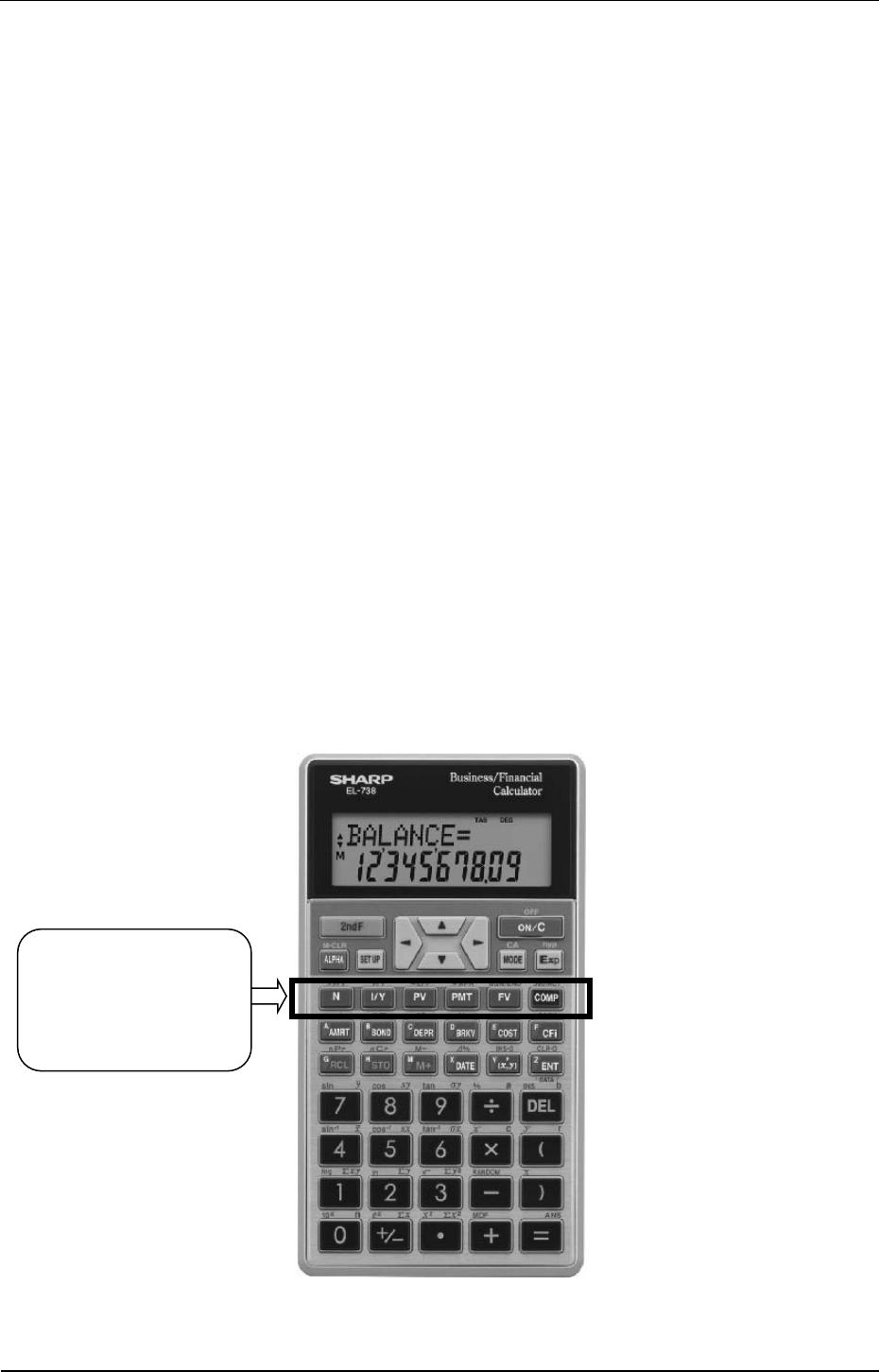
Sharp EL–738 Business Financial
Calculator

Financial Concepts For Property
Page 10 of 126
Last Revised 18 February 2014 Ver 1.0
TOPIC 1: CAPITALISATION PRINCIPLES
Introduction
In this topic we will review the capitalisation method or income approach to
determining the value of income producing properties.
To do so, we will look at the components of rent, both on the income and the
expenditure sides, so that we may determine the net income of a particular property.
This return equates to the net rent or the yield of the property. It is when this yield is
calculated, that a clear multiplier and capitalisation rate can be derived against the
original sales or purchase price of a property.
You will see the clear reciprocal relationship between that yield, and how long the
income stream would take to replace the original cost of an investment property. This
theory and the relationships just mentioned are crucial to the way a valuer assigns
values for income producing property.
Learning Outcomes
Upon completion of this topic you will be able to:
• demonstrate the relationship between income, capitalisation and capital value
• demonstrate the reciprocal relationship between capitalisation and years
purchase.
• apply capitalisation rates and years purchase concepts
• calculate gross and net rents
• identify categories of outgoings and factors affecting them
• identify determinants and selection of capitalisation rates
Capitalisation and Years Purchase
The valuation of income producing property is normally assessed by the
capitalisation of the net return/rental achieved from the property.
This method is termed the capitalisation or income approach.
It considers expected monetary returns from a property, in the light of the return on
investment currently being demanded by investors.
The monetary returns are capitalised. This is the process by which the present value
of future income is expressed as a capital sum. The sum to be found is that at which
the annual rate of return or interest appropriate to the class of investment will be
provided by the net rent or income. Freehold properties are capitalised in perpetuity.
One hundred (100) represents the mathematical equivalent of perpetuity.

Financial Concepts For Property
s:\userdata\documents\advanced valuation\financial analysis 16634\financial concepts
for property.docx
Page 11 of 126
Critical Assumptions about income: annually in arrears; in perpetuity.
To apply the capitalisation method of valuation, careful determination of the following
must be made:
• the net income of the property – before any interest but after the deduction of
all operating expenses
• the remaining economic life expectancy of the property
• the applicable rate of capitalisation.
This method of valuation, as a rule, is limited in application to property that is
primarily used for income or investment purposes. The value of an investment
property is normally assessed by the capitalisation of the net rental return.
Capitalisation Rate
The capitalisation rate is the ratio between the net return and the property value, it is
the percentage return received from an income producing property (as opposed to an
interest rate) and is expressed in the following formula:
?????????????? ????= ??? ??????
??????? ????? × 100
Where net income is the net amount remaining after all outgoings are deducted from
the gross rent, based on the following formula:
??? ?????? = ????? ?????? − ?????????
Gross income: is all income derived from an income producing property.
Outgoings: are those expenditure items associated with the running of a property.
Example: Calculation of Net Income
A building of four units, each returns $230 per week.
Gross Income
$230 per week x 4 x 52 weeks
$47,840
Outgoings(statutory& operating expenses)
Council Rates
$2,800
Water Rates
$1,460
Insurance
$980
Management Fee
$3,350
$8,590
Net Income
$39,250

Financial Concepts For Property
Page 12 of 126
Last Revised 18 February 2014 Ver 1.0
Example: Calculating the Capitalisation Rate
If we were to use the previous example of the block of four units, and that property
had sold for $500,000. What would be the capitalisation rate?
?????????????? ????
= ??? ??????
??????? ????? × 100
= $39,250
$500,000 ×100
= 7.85%
Variations to the above formula allow valuers to determine the value of an income
producing property:
??????? ?????=??? ?????? × 100
?????????????? ????
Therefore;
??????? ?????=$39,250 × 100
7.85 = $500,000
Years Purchase
The term years purchase refers to the number of years required for the net return
from the property (investment) to equal (replace) the purchase price.
It is found using the following formula:
????? ????ℎ??? =??????? ?????
??? ??????
Using the figures from Example 2, the calculation of Years Purchase (YP) would be:
????? ????ℎ??? =$500,000
$39,250 = 12.74
Thus 12.74 is a multiplier against the net income of a property and it is called Years
Purchase, that is, it would take the property 12.74 years to pay for itself.
Reciprocal Relationship
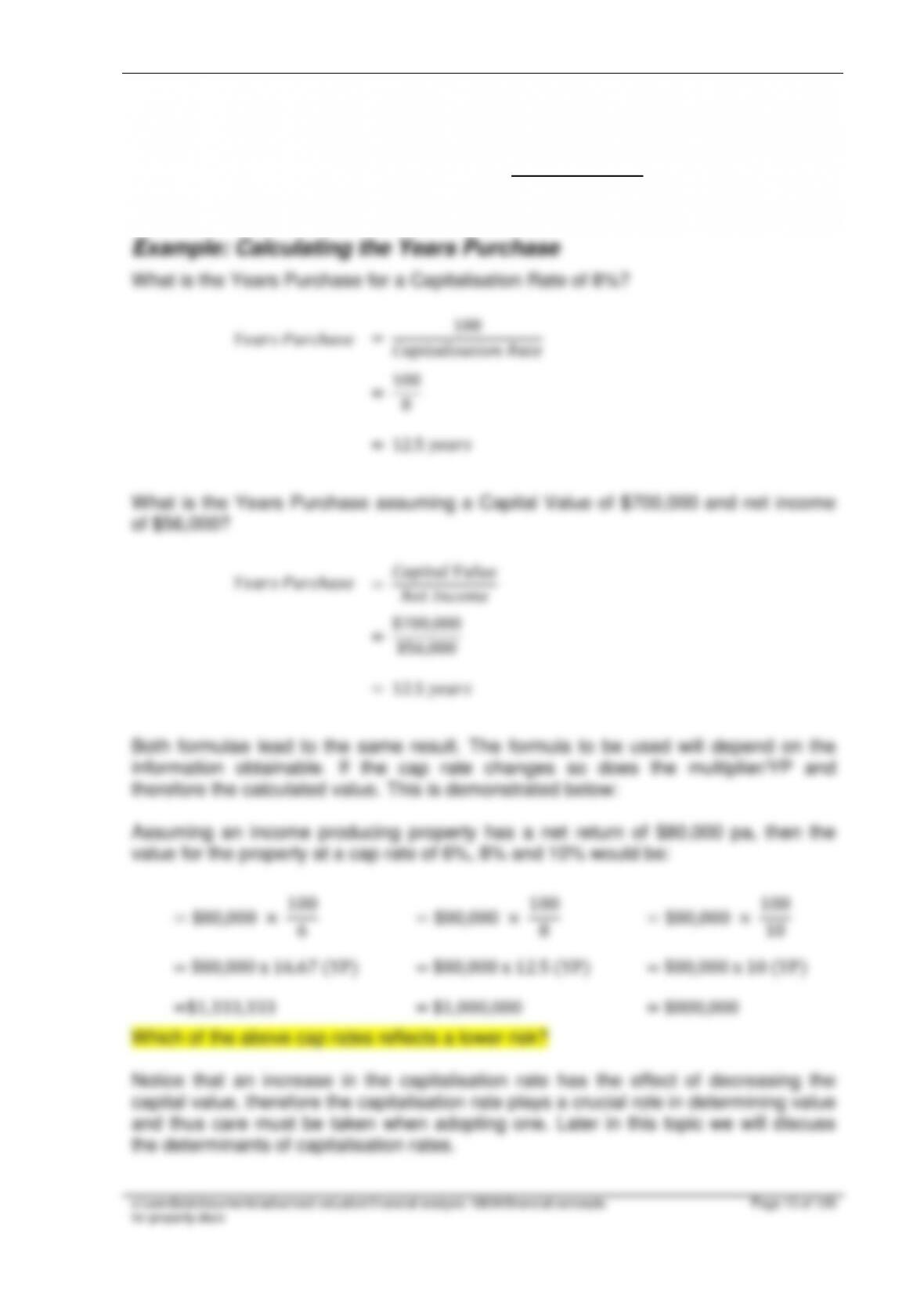
The Years Purchase is the reciprocal of the Capitalisation Rate. It can also be
calculated by the following formula:
????? ????ℎ???=100
?????????????? ????

Financial Concepts For Property
Conversely, the Capitalisation Rate can also be calculated by the following formula:
?????????????? ????=100
????? ????ℎ???