C-168
In 2018, Tesla was one of the most talked about com–
panies in the world. What had started as an unlikely
and risky venture to produce an all-electric luxury
sports car had grown into a company with almost
$12 billion in annual revenues that produced multiple
car models, owned Solar City (a solar panel leasing
company), and produced energy storage systems (e.g.,
Powerwall) and solar roofs (see select items and seg-
ment data in Table 1, and full financials in Exhibits 1
and 2). Though it was not yet posting profits, it had
a market capitalization of over $47 billion. Most im-
portantly, it looked like it might survive—perhaps
even thrive. This was astonishing, because there had
been no other successful auto manufacturing startup
in the United States since the 1920s.
The road leading up to Tesla’s position in 2018 had
been anything but smooth, and many were still betting
against the company. In fact, as of August 2018, the
company had over $13 billion worth of shares sold
short (i.e., shares that investors borrow to sell, betting
that the price will drop so that they can buy shares to
replace those borrowed at a lower price).1
In 2017, Tesla delivered 103,020 cars (see Table 2),
a 35-percent rise over its 2016 figures. In the first
quarter of 2018, Tesla delivered 29,980 cars, of
which almost one-third were its newest model, the
Model 3. The company also had a growing waiting
list for all three cars, highlighting both a strength
and a weakness of the company: People were en–
thusiastic about the cars, and demand was high, but
Tesla was having trouble ramping up production to
meet that demand.
Some of the production capacity for its earlier
models, Model S and Model X, had been reallocated
to production of the new Model 3, and getting the
new model’s production up and running had been
rougher than expected. The company’s CEO, Elon
Musk, had forecasted producing 5,000 Model 3 cars
15
Tesla, Inc. In 2018
This case was prepared by Melissa A. Schilling
of the School of Business, New York University.
Items from Income Statement
Automotive Sales 8,534,752
Automotive Leasing 1,106,548
Total Automotive Revenues 9,641,300
Energy Generation and Storage 1,001,185
Services and other 1,116,266
Total Revenues 11,758,751
Cost of Revenue 9,536,24
Gross Profit 2,222,487
R&D Expense 1,278,073
Sales, General and Admin. 2,476,500
Operating Income (1,632,086)
Table 1 Select Items from Tesla Income
Statement, in $US Thousands
Source: Tesla 2018 10K.
Tono Balaguer/holbox/Shutterstock.com
Copyright 2020 Cengage Learning. All Rights Reserved. May not be copied, scanned, or duplicated, in whole or in part. Due to electronic rights, some third party content may be suppressed from the eBook and/or eChapter(s).
Editorial review has deemed that any suppressed content does not materially affect the overall learning experience. Cengage Learning reserves the right to remove additional content at any time if subsequent rights restrictions require it.
Case 15 Tesla, Inc. in 2018
C-169
a sports car that would be environmentally friendly–
he had concerns about global warming and U.S. de-
pendence on the Middle East for oil. When he didn’t
find the car of his dreams on the market, he began
contemplating building one himself, even though he
had zero experience in the auto industry. Eberhard
noticed that many of the driveways that had a Toyota
Prius hybrid electric vehicle (or “dorkmobile” as he
called it) also had expensive sports cars in them, mak-
ing him speculate that there could be a market for a
high-performance, environmentally friendly car. As
Eberhard explained: “It was clear that people weren’t
buying a Prius to save money on gas. Gas was sell-
ing close to ination-adjusted all-time lows. They
were buying them to make a statement about the
environment.”2
Eberhard began to consider a range of alterna-
tive fuel options for his car: hydrogen fuel cells, natu-
ral gas, diesel. However, he soon concluded that the
highest efficiency and performance would come from
an entirely electric vehicle. Luckily for Eberhard,
Al Cocconi (founder of AC Propulsion and one
of the original engineers for GM’s ill-fated EV-1)
had concluded the same thing and produced a car
called the tzero. The tzero could go from zero to
60 miles per hour in 4.1 seconds, but it was powered
with extremely heavy lead-acid batteries, limiting its
range to about 60 miles between charges. Eberhard
approached Cocconi with the idea of using lighter,
lithium ion batteries, which offered six times more en-
ergy per pound. Cocconi was eager to try out the idea
(he had, in fact, been experimenting with lithium ion
batteries), and the resulting lithium ion powered tzero
accelerated to 60 miles per hour in 3.6 seconds and
could travel more than 300 miles. Eberhard licensed
the electric-drive-train technology from AC Propul-
sion, and founded his company, Tesla Motors (named
after Nikola Tesla, a late 19th- and early 20th-century
inventor who developed, among other things, the AC
electrical system used in the United States today).3
Meanwhile, another entrepreneur–one with much
deeper pockets–was also interested in developing
electric vehicles based on the tzero: Elon Musk. In
2002, Musk was a 31-year-old South African living
in California, who had founded a company that ulti-
mately became PayPal. After selling PayPal to eBay
in 2002 for $1.5 billion, he started a company called
SpaceX with the ambitious goal of developing cheap,
consumer space travel. (SpaceX’s Dragon spacecraft
a week by the end of the first quarter of 2018, but
instead production was closer to 1,000 cars a week by
the end of the first quarter, triggering an onslaught of
criticism by analysts.
To make matters worse, the company’s rapid ex-
pansion of production capacity meant that it would
likely require additional capital within the year, caus-
ing stockholders to worry about dilution of their
shares. Tesla had made bold moves and impressive
progress, but there were lingering concerns over its vi-
ability. Would it be able to turn a sustainable profit
on its automaking operations? In the niche market
of luxury automobiles for the “eco-wealthy,” it had
a privileged position with customers who were rela-
tively price-insensitive and were seeking a stylish,
high-performance car that made an environmental
statement. To compete for the mass market, the car
would have to compete on value and efficiency with
larger, more established rivals.
CI5-1 HISTory of TeSla
In 2003, an engineer named Martin Eberhard was
looking for his next big project. A tall, slim man
with a mop of gray hair, Eberhard was a serial en-
trepreneur who had launched a number of startups,
including NuvoMedia, which he sold to Gemstar in
a $187-million deal. Eberhard was also looking for
Table 2 Tesla deliveries in 2017 and 2018
Model S Model X Model 3 Total
2017
Q1 13,450 11,550 25,000
Q2 12,000 10,000 22,000
Q3 14,065 11,865 220 26,150
Q4 15,200 13,120 1,550 29,870
Total 54,715 46,535 1,770 103,020
2018
Q1 11,730 10,070 8,180 29,980
Copyright 2020 Cengage Learning. All Rights Reserved. May not be copied, scanned, or duplicated, in whole or in part. Due to electronic rights, some third party content may be suppressed from the eBook and/or eChapter(s).
Editorial review has deemed that any suppressed content does not materially affect the overall learning experience. Cengage Learning reserves the right to remove additional content at any time if subsequent rights restrictions require it.

C-170
Case 15 Tesla, Inc. in 2018
power the car, they connected nearly 7,000 small,
cylindrical 18650 lithium-batteries together into a
pack. 18650 batteries are the type used in many con-
sumer devices, including laptops, and over a billion a
year are manufactured. This meant that the Roadster
was using a battery that had been thoroughly
“debugged,” that already had a good ratio of energy
capacity to price, and for which there was already large
production capacity.
While the men worked well together at first, per–
sonality clashes soon emerged. Both were technically
savvy and vigorously addressed problems within the
company. As described by Laurie Yoler, Eberhard
was “just brilliant, and he has this tenacity that is
unbelievable . . . He is the guy you want around in
those early days when you have naysayers all around.”
However, Eberhard could also be abrasive and criti–
cal. Musk, in turn, was not content to just finan–
cially back the company. He began to get intimately
involved in decisions about the car’s design and the
operation of the company. Soon Musk and Eberhard
were at odds over decision making. Eberhard pre–
ferred to stick with the fiberglass body panels used
in the original Elise; Musk wanted to use the lighter,
stronger–and more expensive–carbon fiber. Eberhard
had approved the hiring of PR professionals to build
publicity for the car before its launch; Musk fired them,
believing his own involvement and the car itself
would generate enough publicity. Eberhard wanted to
reap the cost savings of sticking with the Elise’s origi–
nal crash-tested, off-the-rack chassis; Musk wanted
to lower the doorsills by two inches to make the car
easier to enter and exit. Musk also wanted to rede–
sign the headlights and door latches, and replace the
Elise’s seats with more comfortable–and again, more
expensive–custom seats.7
In each case, Musk prevailed. He insisted that
“you can’t sell a $100,000 car that looks like crap.”
Musk’s views were hard to ignore given that, by 2007,
he had put $55 million of his own money into the
company and had also raised money from wealthy
friends, including eBay’s second employee, Jeff Skoll,
and Google founders Sergey Brin and Larry Page.
Musk’s insistence on the best materials and parts,
however, combined with Eberhard’s inexperience as
the manager of a major firm, resulted in delays and
runaway costs. At a staff meeting in June 2007, Tom
Colson, head of manufacturing, revealed a cost anal-
ysis suggesting that the average cost of the cars would
ultimately made history in May 2012 by becoming
the first commercial vehicle to launch and dock at the
International Space Station.4) Musk’s assertive style
and astonishing record of high-tech entrepreneurship
made him one of the inspirations for the Tony Stark
character in Jon Favreau’s Iron Man movies.
Like Eberhard, Musk thought electric cars were
the key to the United States achieving energy indepen–
dence, and he approached Cocconi about buying the
tzero. Tom Gage, who was then AC Propulsion’s CEO,
suggested that Musk collaborate with Eberhard. After
a two-hour meeting in February 2004, Musk agreed
to fund Eberhard’s plan with $6.3 million. He would
be the company’s chairman; Eberhard would serve
as CEO.
cI5-1a The Roadster
The first Tesla prototype, the Roadster, was based
on the $45,000 Lotus Elise, a fast, light sports car
that seemed perfect for the creation of Eberhard and
Musk’s grand idea (see Figure 1). The car would have
400 volts of electric potential, liquid-cooled, lithium
ion batteries, and a series of silicon transistors that
would give the car acceleration so powerful the driver
would be pressed back against the seat.5 It would be
nearly as fast as a Porsche 911 Turbo, would not cre-
ate a single emission, and would get about 220 miles
on a single charge from the kind of outlet you would
use to power a washing machine.6 Furthermore,
rather than creating new large-format batteries to
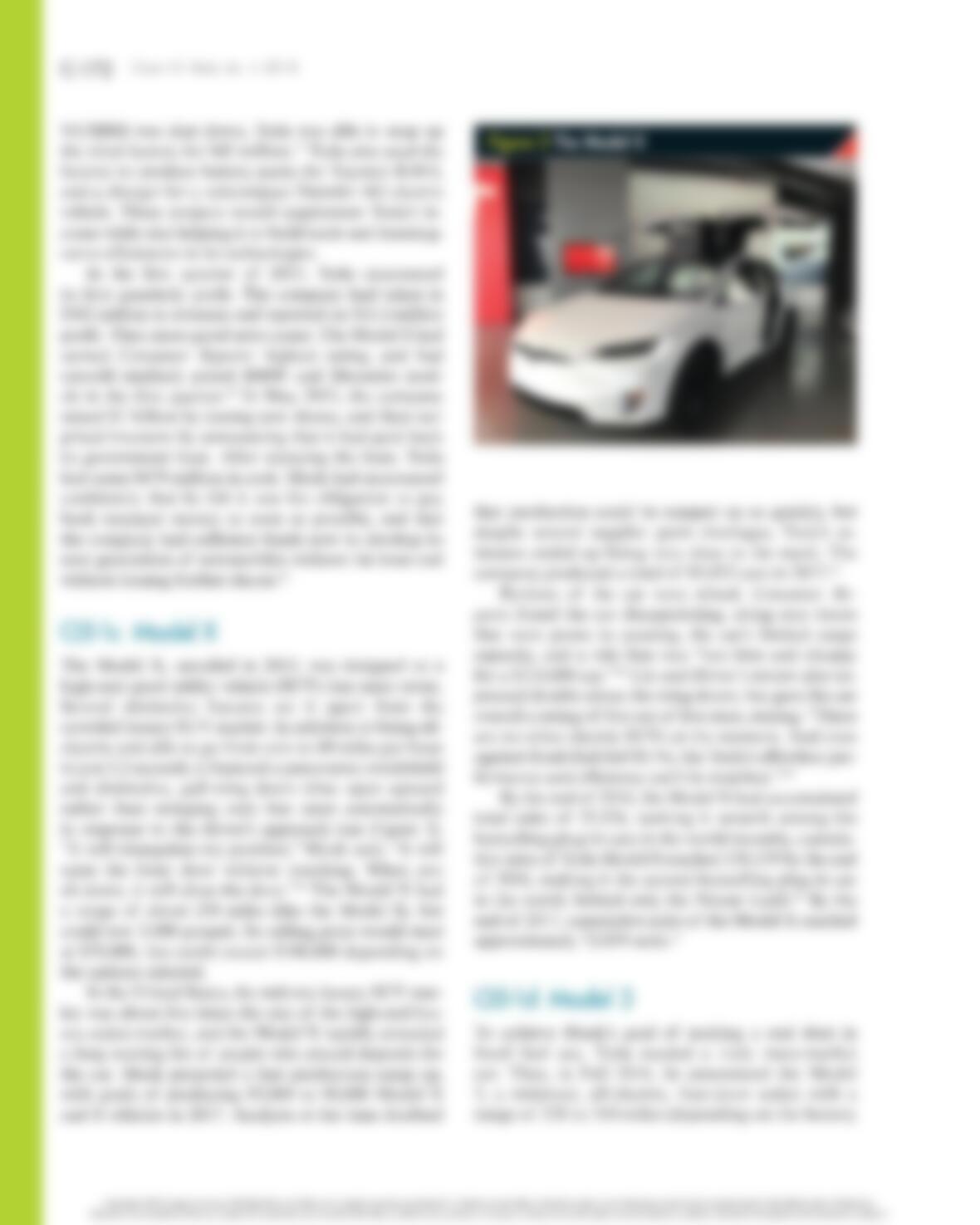
figure 1 The roadster
Copyright 2020 Cengage Learning. All Rights Reserved. May not be copied, scanned, or duplicated, in whole or in part. Due to electronic rights, some third party content may be suppressed from the eBook and/or eChapter(s).
Editorial review has deemed that any suppressed content does not materially affect the overall learning experience. Cengage Learning reserves the right to remove additional content at any time if subsequent rights restrictions require it.
Case 15 Tesla, Inc. in 2018
C-171
cost $500 million to develop; however, offsetting that
cost was a $465-million loan Tesla received from the
U.S. government to build the car, part of the U.S.
government’s initiative to promote the development
of technologies that would help the United States
achieve energy independence.
be over $100,000 for the first 50, and would decline
only slightly with increased volume. Eberhard could
not answer the financial questions of the venture capi-
talists on Tesla’s board, and their confidence in him
was eroded even further by his defense: “In any other
company it’s the CFO that provides those numbers . . .
I’m an engineer, not a finance guy.” In August 2007,
the board removed him as CEO and demoted him to
president of technology. In October 2007, Musk ar-
ranged for Eberhard to be ousted from the company
entirely. Furious, Eberhard started a blog detailing
what he called the “Stealth Bloodbath” going on at
Tesla, and he would later sue Musk for libel, slander,
and breach of contract.8
Meanwhile, Eberhard’s temporary replacement was
Michael Marks, former CEO of Flextronics. Marks
im mediately created a priority list that identified
items with potential to delay the car. He mothballed
any plans for side projects and focused the entire
business on streamlining costs and launching the
Roadster. Despite his efforts, the Roadster missed
its deadline for beginning production at the Lotus
facility, triggering a $4-million penalty built into
the manufacturing contract Eberhard had signed
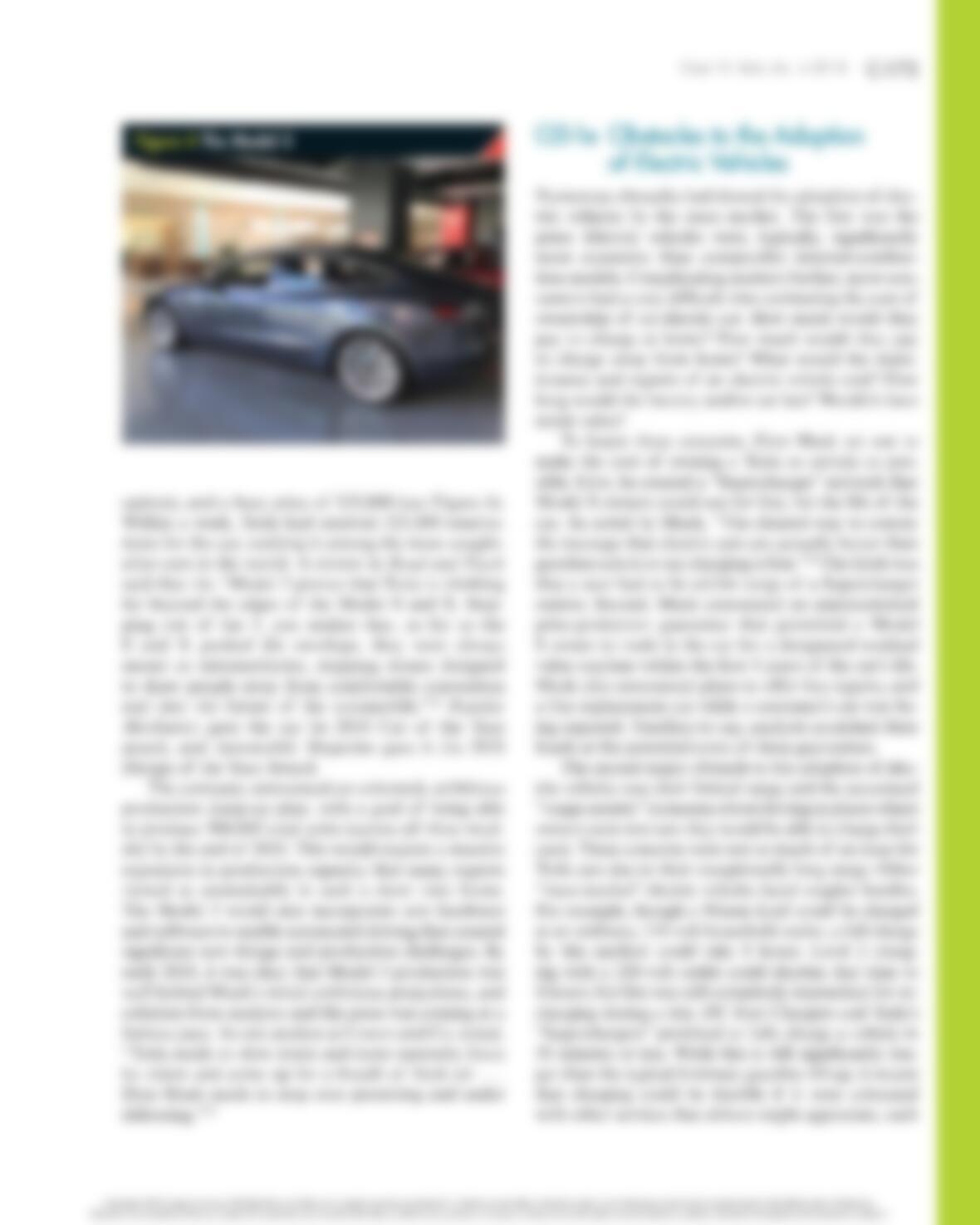
figure 2 The Model S