10Chapter
Managing Work
Groups and
Work Teams
10-1
1

Learning Outcomes
•Define group and describe the stages of
group development.
•Describe the major concepts of group
behavior.
•Discuss how groups are turned into effective
teams.
•Discuss contemporary issues in managing
teams.
10-2
After studying this chapter, you will be able to:
•Define group and describe the stages of group development.
•Describe the major concepts of group behavior.
•Discuss how groups are turned into effective teams.
•Discuss contemporary issues in managing teams.
2
10-3
3
What Is a Group?
10-4
A group is composed of two or more interacting and interdependent individuals who
come together to achieve specific goals. Formal groups are work groups that are
defined by the organization’s structure and have designated work assignments and
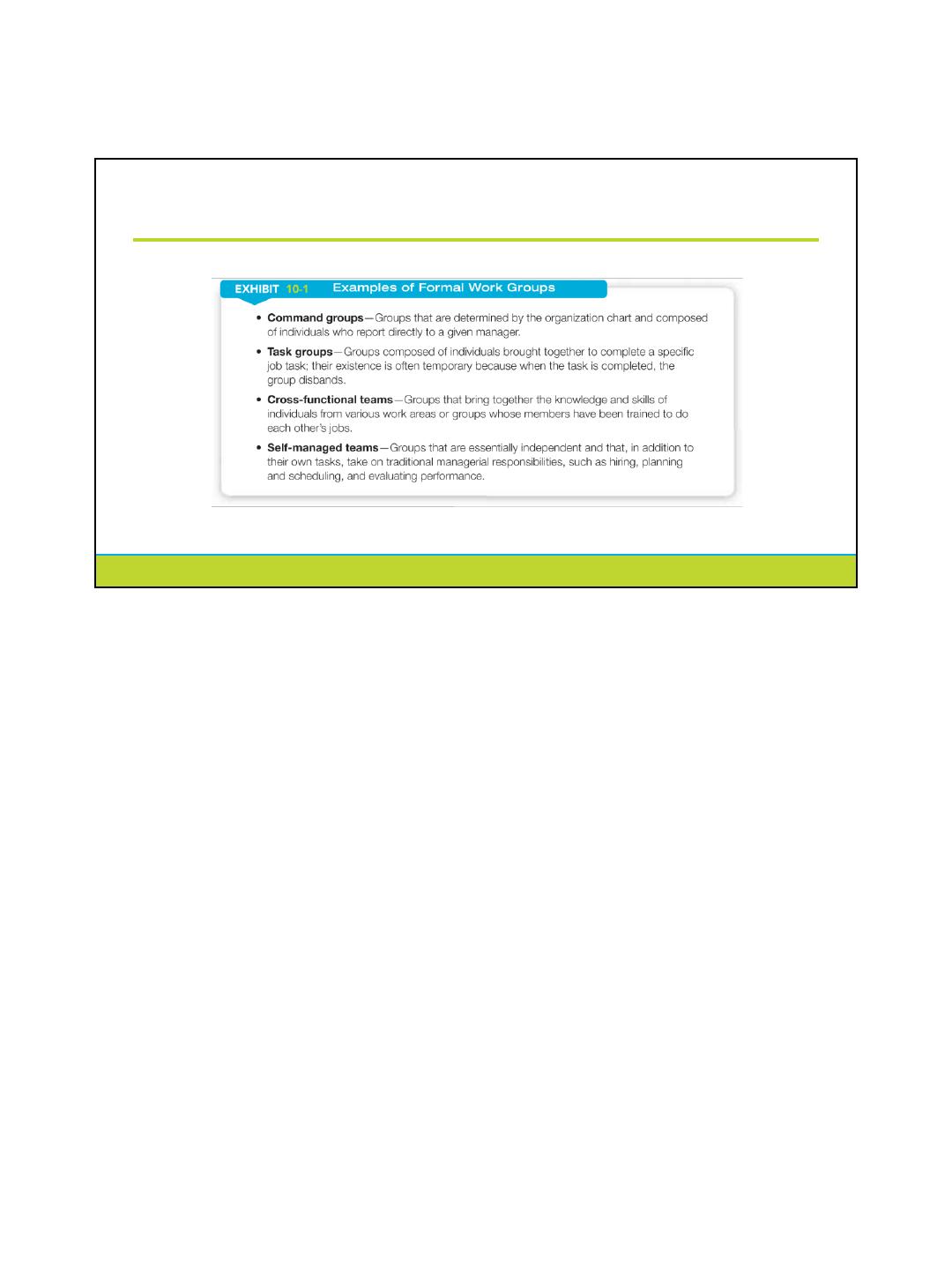
specific tasks directed at accomplishing organizational goals. Here in Exhibit 10-1 we
can see several examples of such formal work groups, including command groups,
task groups, cross-functional teams, and self-managed teams.
•Command groups are determined by the organization chart and composed of
individuals who report directly to a given manager.
•Task groups are often temporary and are composed of individuals brought
together to complete a specific job task.
•Cross-functional teams bring together the knowledge and skills of individuals
from various work areas, or are groups whose members have been trained to
do each other’s jobs.
•Self-managed teams are essentially independent. In addition to their own
tasks, they take on traditional managerial responsibilities such as hiring,
planning and scheduling, and evaluating performance.
Informal groups are social groups that occur naturally in the workplace and tend to
form around friendships and common interests.
4
10-5
5

Stages of Group Development
10-6
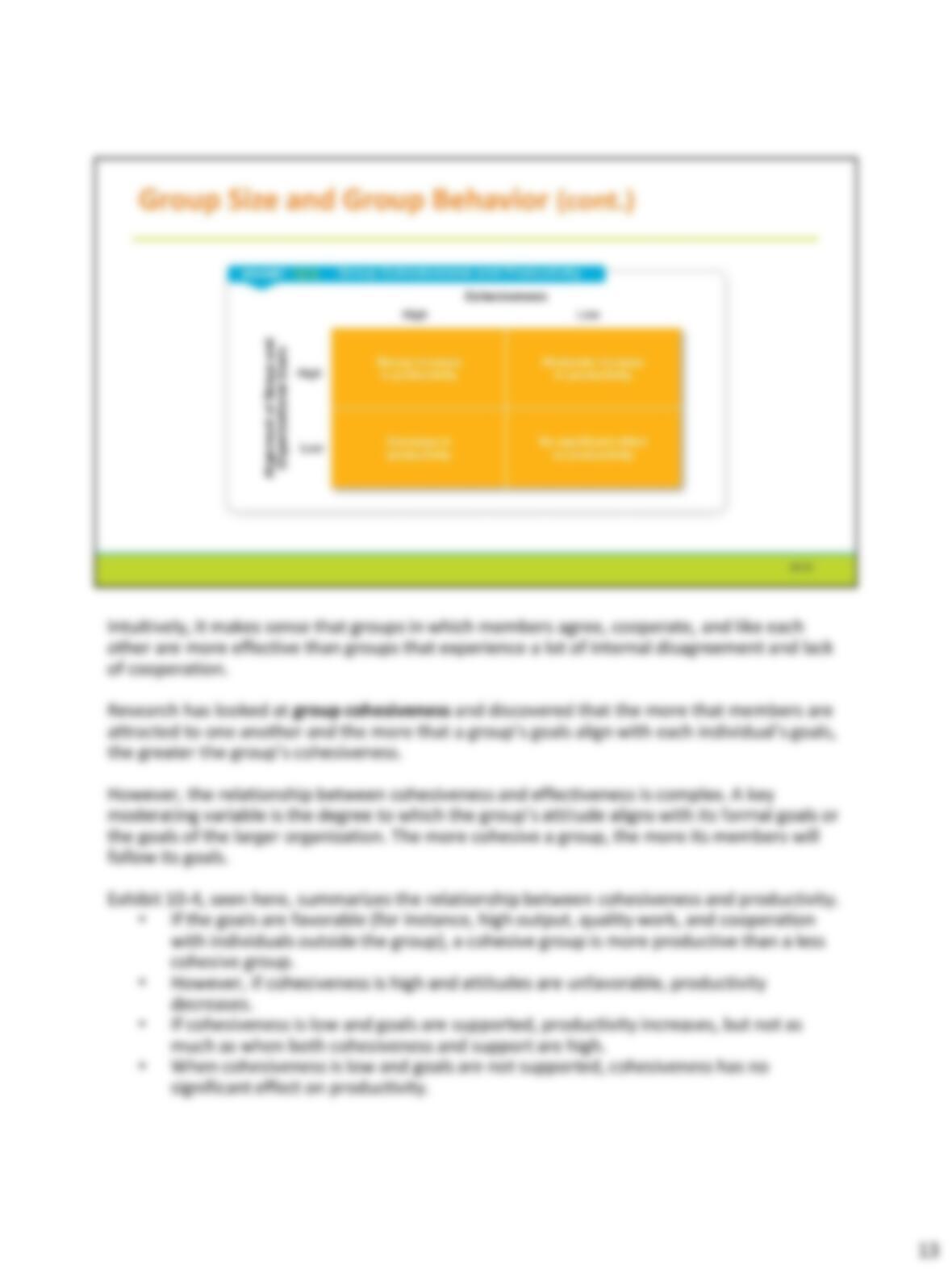
Research shows that groups develop through the five stages shown here in Exhibit 10-2:
1. Forming
2. Storming
3. Norming
4. Performing, and
5. Adjourning.
The forming stage has two phases. The first phase is when people first join the group and the second
phase is when they define the group’s purpose, structure, and leadership. The latter phase involves a
great deal of uncertainty as members “test the waters” to determine acceptable behaviors and is
complete when members begin to think of themselves as part of a group.
The storming stage is named because it is the period of intragroup conflict about who will control the
group and what the group needs to be doing. This stage is complete when a relatively clear hierarchy
of leadership and agreement on the group’s direction is evident.
The norming stage is one in which close relationships develop and the group becomes cohesive.
During this phase the group demonstrates a strong sense of group identity and camaraderie. This
stage is complete when the group structure solidifies and the group has assimilated a common set of
expectations (or norms) regarding member behavior.
The fourth stage is the performing stage. The group structure is in place and accepted by group
members. Their energies have moved from getting to know and understand each other to working on
the group’s task. This is the last stage of development for permanent work groups.
However, for temporary groups—such as project teams, task forces, or similar groups that have a
limited task to do—the final stage is the adjourning stage in which the group prepares to disband.
Attention is focused on wrapping up activities instead of task performance.
6

Stages of Group Development (cont.)
10-7
Of course, some groups don’t get beyond the forming or storming stages. These
groups may have serious interpersonal conflicts, turn in disappointing work, and get
poor performance reviews.
The assumption that a group becomes more effective as it progresses through the
first four stages may be generally true, but what makes a group effective is complex.
Under some conditions, high levels of conflict are conducive to high levels of group
performance. There might be situations in which groups in the storming stage