Archives
978-1111138271 Chapter 1
CHAPTER 1 Chapter Overview Speech motor disorders is a collection of speech production deficits, caused by abnormal functioning of the motor system. Motor refers to the part of the nervous system that controls voluntary movements (motor system), speech refers to […]
978-1111138271 Chapter 10
CHAPTER 10 Chapter Overview Mixed dysarthria is a motor speech disorder that can occur when neurological damage extends to two or more parts of the nervous system, and is characterized by a combination of the traits found in single (or […]
978-1111138271 Chapter 11
CHAPTER 11 Chapter Overview Apraxia of speech (AOS) is a disorder of motor sequencing. In some definitions, it is noted to be a phonetic-motoric disorder. It is not caused by muscle weakness, abnormal muscle tone, reduced range of movement, or […]
978-1111138271 Chapter 2
CHAPTER 2 Chapter Overview The parts of the nervous system that control voluntary movement are collectively referred to as the “motor system.” The motor system is a complex system whereby thought is turned into movement. When functioning properly, numerous muscles […]
978-1111138271 Chapter 3
CHAPTER 3 Chapter Overview Evaluating and diagnosing motor speech disorders is often a challenging task for beginning clinicians for a few reasons: it can be difficult to distinguish among the dysarthrias, as many of the speech characteristics of one dysarthria […]
978-1111138271 Chapter 4
CHAPTER 4 Chapter Overview Flaccid dysarthria is a motor speech disorder with neuropathology of damage to the motor units of the cranial or spinal nerves that supply speech muscles (lower motor neuron involvement); speech problems are caused mostly by muscle […]
978-1111138271 Chapter 5
CHAPTER 5 Chapter Overview Spastic dysarthria is a motor speech disorder caused by bilateral damage to the upper motor neurons of both the pyramidal and extrapyramidal systems, characterized by imprecise consonants, monotonous pitch, reduced stress, and harsh vocal quality due […]
978-1111138271 Chapter 6
CHAPTER 6 Chapter Overview Unilateral upper motor neuron dysarthria is a motor speech disorder caused by damage to the upper motor neurons on one side of the brain that supply cranial and spinal nerves involved in speech production. It is […]
978-1111138271 Chapter 7
CHAPTER 7 Chapter Overview Ataxic dysarthria is caused by damage to the cerebellum or to the neural pathways that connect the cerebellum to other parts of the central nervous system, resulting in speech errors that are primarily articulatory and prosodic, […]
978-1111138271 Chapter 8
CHAPTER 8 Chapter Overview Hypokinetic dysarthria is caused by any process that damages the basal ganglia (extrapyramidal system). It is manifested in any or all of the respiratory, phonatory, resonatory, and articulatory levels of speech, being most evident in voice, […]
978-1111138271 Chapter 9
CHAPTER 9 Chapter Overview Hyperkinetic dysarthria is a group of various motor speech disorders, each associated with a hyperkinetic movement disorder. The dysarthria is caused by involuntary movements that interfere with voluntary attempts at speech. These disorders mostly seem to […]
978-1111138271 Test Bank Chapter 1
Chapter 1 1 Chapter 1: A Brief Historical Review of Motor Speech Disorders QUESTIONS Multiple Choice 1. Motor speech disorders consist of: A. six types of dysarthria and one type of apraxia B. six types of dysarthria and two types […]
978-1111138271 Test Bank Chapter 10
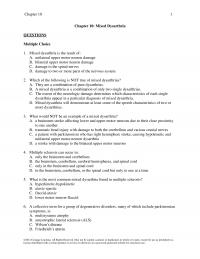
Chapter 10 1 Chapter 10: Mixed Dysarthria QUESTIONS Multiple Choice 1. Mixed dysarthria is the result of: A. unilateral upper motor neuron damage B. bilateral upper motor neuron damage C. damage to the spinal nerves D. damage to two or […]
978-1111138271 Test Bank Chapter 11
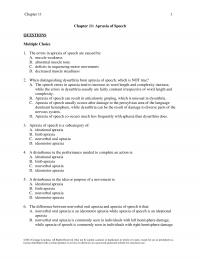
Chapter 11 1 Chapter 11: Apraxia of Speech QUESTIONS Multiple Choice 1. The errors in apraxia of speech are caused by: A. muscle weakness B. abnormal muscle tone C. deficits in sequencing motor movements D. decreased muscle steadiness 2. When […]
978-1111138271 Test Bank Chapter 2
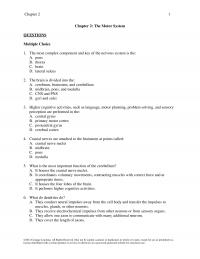
Chapter 2 1 Chapter 2: The Motor System QUESTIONS Multiple Choice 1. The most complex component and key of the nervous system is the: A. pons B. thorax C. brain D. lateral sulcus 2. The brain is divided into the: […]
978-1111138271 Test Bank Chapter 3
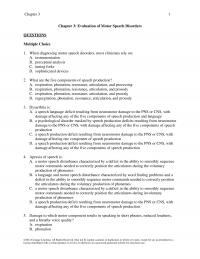
Chapter 3 1 Chapter 3: Evaluation of Motor Speech Disorders QUESTIONS Multiple Choice 1. When diagnosing motor speech disorders, most clinicians rely on: A. instrumentation B. perceptual analysis C. tuning forks D. sophisticated devices 2. What are the five components […]
978-1111138271 Test Bank Chapter 4
Chapter 4 1 Chapter 4: Flaccid Dysarthria QUESTIONS Multiple Choice 1. Flaccid dysarthria is: A. a motor speech disorder caused by disruption of the flow of neural impulses along the upper motor neurons B. a motor speech disorder caused by […]
978-1111138271 Test Bank Chapter 5
Chapter 5 1 Chapter 5: Spastic Dysarthria QUESTIONS Multiple Choice 1. What is one of the features that distinguish spastic dysarthria from flaccid dysarthria? A. Flaccid dysarthria is characterized by imprecise articulation. B. Spastic dysarthria is caused by bilateral damage […]
978-1111138271 Test Bank Chapter 6
Chapter 6 1 Chapter 6: Unilateral Upper Motor Neuron Dysarthria QUESTIONS Multiple Choice 1. Of the following statements regarding unilateral upper motor neuron dysarthria, which of the following is FALSE? A. It was relatively recently that this dysarthria was recognized […]
978-1111138271 Test Bank Chapter 7
Chapter 7 1 Chapter 7: Ataxic Dysarthria QUESTIONS Multiple Choice 1. Ataxic dysarthria is associated with damage to the: A. cerebrum B. cerebellum C. upper motor neurons D. lower motor neurons 2. Which speech systems are most impacted by ataxic […]
978-1111138271 Test Bank Chapter 8
Chapter 8 1 Chapter 8: Hypokinetic Dysarthria QUESTIONS Multiple Choice 1. Which of the following statements regarding hypokinetic dysarthria is TRUE? A. In several ways, hypokinetic dysarthria is unique. B. It is the only dysarthria in which decreased rate of […]
978-1111138271 Test Bank Chapter 9
Chapter 9 Chapter 9: Hyperkinetic Dysarthria QUESTIONS Multiple Choice 1. What is the cause of hyperkinetic dysarthria? A. damage to upper motor neurons B. damage to lower motor neurons C. damage to spinal nerves D. damage to the basal ganglia […]