Archives
Chapter 01 American Consumers answer A21 from 1980 Early 1985 The
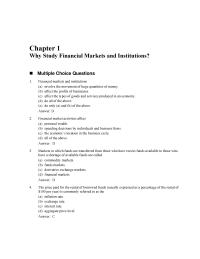
Chapter 1 Why Study Financial Markets and Institutions? ◼ Multiple Choice Questions 1. Financial markets and institutions (a) involve the movement of huge quantities of money. (b) affect the profits of businesses. (c) affect the types of goods and services […]
Chapter 02 Which of the following can be described as involving direct finance
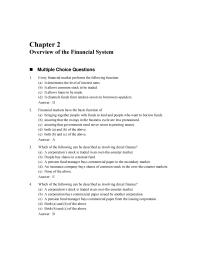
Chapter 2 Overview of the Financial System ◼ Multiple Choice Questions 1. Every financial market performs the following function: (a) It determines the level of interest rates. (b) It allows common stock to be traded. (c) It allows loans to […]
Chapter 03 What Do Interest Rates Mean and What Is Their Role in
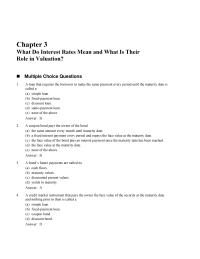
Chapter 3 What Do Interest Rates Mean and What Is Their Role in Valuation? ◼ Multiple Choice Questions 1. A loan that requires the borrower to make the same payment every period until the maturity date is called a (a) […]
Chapter 04 Why Do Interest Rates Change, When the price of a bond is
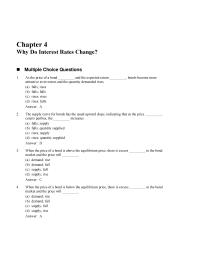
Chapter 4 Why Do Interest Rates Change? ◼ Multiple Choice Questions 1. As the price of a bond _________ and the expected return _________, bonds become more attractive to investors and the quantity demanded rises. (a) falls; rises (b) falls; […]
Chapter 05 When The Corporate Bond Market Becomes
Chapter 5 How Do Risk and Term Structure Affect Interest Rates? ◼ Multiple Choice Questions 1. The term structure of interest rates is (a) the relationship among interest rates of different bonds with the same maturity. (b) the structure of […]
Chapter 06 sometimes One Observes That The Price Company’s
Chapter 6 Are Financial Markets Efficient? ◼ Multiple Choice Questions 1. How expectations are formed is important because expectations influence (a) the demand for assets. (b) bond prices. (c) the risk structure of interest rates. (d) the term structure of […]
Chapter 07 according The Textbook Authors The Fed Isa
Chapter 7 Structure of Central Banks and the Federal Reserve System ◼ Multiple Choice Questions 1. Americans’ fear of centralized power and their distrust of moneyed interests explains why the U.S. did not have a central bank until the (a) […]
Chapter 08 which The Following Not Requirement Selecting Intermediate
Chapter 8 Conduct of Monetary Policy: Tools, Goals, and Targets ◼ Multiple Choice Questions 1. Assets on the Fed’s balance sheet include (a) government securities and currency in circulation. (b) discount loans and reserves. (c) government securities and discount loans. […]
Chapter 09 Which of the following statements about the money market
Chapter 9 The Money Markets ◼ Multiple Choice Questions 1. Activity in money markets increased significantly in the late 1970s and early 1980s because of (a) rising short-term interest rates. (b) regulations that limited what banks could pay for deposits. […]
Chapter 10 Institutions Fifth Edition the Bond Contract That States
Chapter 10 The Bond Market ◼ Multiple Choice Questions 1. Compared to money market securities, capital market securities have (a) more liquidity. (b) longer maturities. (c) lower yields. (d) less risk. 2. (I) Securities that have an original maturity greater […]
Chapter 11 The Stock Market according The Gordon Growth
Chapter 11 The Stock Market ◼ Multiple Choice Questions 1. (I) A share of common stock in a firm represents an ownership interest in that firm. (II) A share of preferred stock is as much like a bond as it […]
Chapter 12 Conventional mort gages Not Allow Borrower Take Advantage Falling
Chapter 12 The Mortgage Markets ◼ Multiple Choice Questions 1. Which of the following are important ways in which mortgage markets differ from the stock and bond markets? (a) The usual borrowers in the capital markets are government entities and […]
Chapter 13 When the value of the British pound changes from $1.50 to $1.25
Chapter 13 The Foreign Exchange Market ◼ Multiple Choice Questions 1. American firms became less competitive compared to foreign firms during the 1980s because (a) the quality and productivity of American workers declined. (b) foreign firms were younger than American […]
Chapter 14 The International Financial System revaluation Currency’s Value
Chapter 14 The International Financial System ◼ Multiple Choice Questions 1. A central bank sale of _________ to purchase _________ in the foreign exchange market results in an equal rise in its international reserves and the monetary base. (a) foreign […]
Chapter 15 commercial And Farm Mortgages Which Property Pledged
Chapter 15 Why Do Financial Institutions Exist? ◼ Multiple Choice Questions 1. Of the following sources of external finance for American nonfinancial businesses, the least important is (a) loans from banks. (b) stocks. (c) bonds and commercial paper. (d) nonbank […]
Chapter 16 Which combination of activities within a single
Chapter 16 What Should We Do About Conflicts of Interest in the Financial Industry? ◼ Multiple Choice Questions 1. Economies of scope refer to cost savings that arise when the (a) size of financial transactions increase. (b) size of financial […]
Chapter 17 Which of the following statements is false
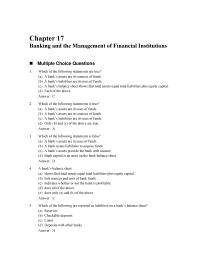
Chapter 17 Banking and the Management of Financial Institutions ◼ Multiple Choice Questions 1. Which of the following statements are true? (a) A bank’s assets are its sources of funds. (b) A bank’s liabilities are its uses of funds. (c) […]
Chapter 18 the Legislation That Separated Investment Banking From
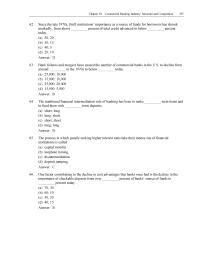
Chapter 18 Commercial Banking Industry: Structure and Competition 235 62. Since the late 1970s, thrift institutions’ importance as a source of funds for borrowers has shrunk markedly, from above _________ percent of total credit advanced to below _________ percent today. […]
Chapter 18 while non-member commercial banks could choose to buy
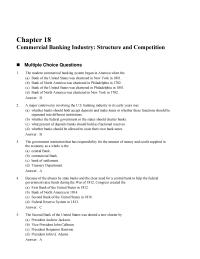
Chapter 18 Commercial Banking Industry: Structure and Competition ◼ Multiple Choice Questions 1. The modern commercial banking system began in America when the (a) Bank of the United States was chartered in New York in 1801. (b) Bank of North […]
Chapter 19 that Taxpayers Were Poorly Served Thrift Regulators
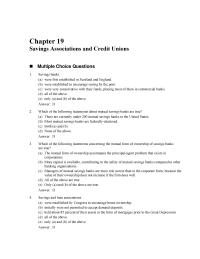
Chapter 19 Savings Associations and Credit Unions ◼ Multiple Choice Questions 1. Savings banks (a) were first established in Scotland and England. (b) were established to encourage saving by the poor. (c) were very conservative with their funds, placing most […]
Chapter 20 Banking Regulation the Chartering Process Especially Designed
Chapter 20 Banking Regulation ◼ Multiple Choice Questions 1. During the boom years of the 1920s, bank failures were quite (a) uncommon, averaging less than 30 per year. (b) uncommon, averaging less than 100 per year. (c) common, averaging about […]
Chapter 21 which The Following Most Likely No load Fund a
Chapter 21 The Mutual Fund Industry ◼ Multiple Choice Questions 1. Mutual funds hold about _________ of financial intermediaries’ total assets. (a) one-sixth (b) one-fourth (c) one-half (d) two-thirds 2. _________ intermediation means that small investors can pool their funds […]
Chapter 22 All The Above answer insurance Companies Attempts Minimize
Chapter 22 Insurance Companies and Pension Funds ◼ Multiple Choice Questions 1. The earliest form of insurance was _________ insurance. (a) life (b) health (c) automobile (d) property and casualty 2. The certainty equivalent for risk-averse people who buy insurance […]
Chapter 23 There Difference Between Brokers And Dealers answer securities
Chapter 23 Investment Banks, Security Brokers and Dealers, and Venture Capital Firms ◼ Multiple Choice Questions 1. An investment bank is a financial institution that (a) bundles small deposits into larger loans. (b) helps corporations raise funds. (c) holds most […]
Chapter 24 A bank’s commitment (for a specified future period of time)
Chapter 24 Risk Management in Financial Institutions ◼ Multiple Choice Questions 1. Banks face the problem of _________ in loan markets because bad credit risks are the ones most likely to seek bank loans. (a) adverse selection (b) moral hazard […]
Chapter 25 A contract that requires the investor to sell securities on a future
Chapter 25 Hedging with Financial Derivatives ◼ Multiple Choice Questions 1. Financial derivatives include (a) stocks. (b) bonds. (c) futures. (d) none of the above. 2. Financial derivatives include (a) stocks. (b) bonds. (c) forward contracts. (d) both (a) and […]