Archives
SED AP 17191
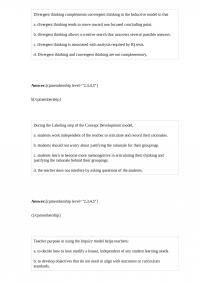
Divergent thinking complements convergent thinking in the Inductive model in that a. divergent thinking tends to move toward one focused concluding point. b. divergent thinking allows a creative search that uncovers several possible answers. c. divergent thinking is associated with […]
SED AP 51278
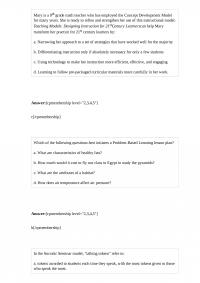
Mary is a 9th grade math teacher who has employed the Concept Development Model for many years. She is ready to refine and strengthen her use of this instructional model. Teaching Models: Designing Instruction for 21stCentury Learnerscan help Mary transform […]
SED AP 86080
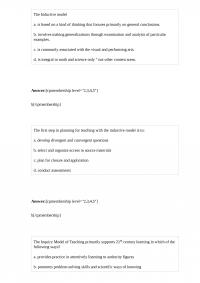
The Inductive model a. is based on a kind of thinking that focuses primarily on general conclusions. b. involves making generalizations through examination and analysis of particular examples. c. is commonly associated with the visual and performing arts. d. is […]
SED CE 46177
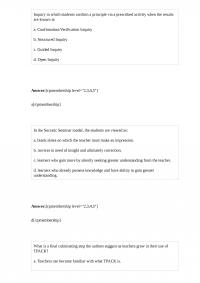
Inquiry in which students confirm a principle via a prescribed activity when the results are known is: a. Confirmation/Verification Inquiry b. Structured Inquiry c. Guided Inquiry d. Open Inquiry In the Socratic Seminar model, the students are viewed as: a. […]
SED CE 62622
What is involved in the second phase of the Integrative model? a. Students describe, compare, and search for patterns in the content that represents an organized body of knowledge. b. Students make broad generalizations about the content, and form synthesizing […]
SED EM 44445
Recognizing that a donkey is not an example of a horse represents the process of: a. generalization b. discrimination of a far out nonexample c. discrimination of a close in nonexample d. creation of a rational set of purposefully selected […]
SED EM 63317
Which of the following is a question to consider in the Develop phase of the ADDIE model? a. How much growth occurred from the beginning to end of instruction? b. What must I teach to fulfill state, district, and local […]
SED LR 66945
Key ways in which globalization has impacted the field of education include which of the following? a. More homogenous classrooms, broader teacher and student perspectives, more global social networks, and more rigorous education standards b. More diverse classrooms, more traditional […]
SED LR 90539
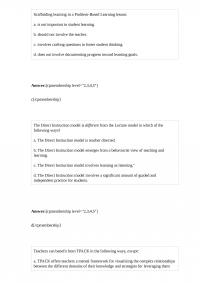
Scaffolding learning in a Problem-Based Learning lesson: a. is not important to student learning. b. should not involve the teacher. c. involves crafting questions to foster student thinking. d. does not involve documenting progress toward learning goals. The Direct Instruction […]