Archives
CAS HI 26944
Which of the following is true for the period between 1860 and 1910? (a) The number of people in the labor force increased at a faster pace than the total population. (b) The workday lengthened. (c) Real national income decreased. […]
CAS HI 65264
Ames and Rosenberg (1963) argue that demand for manufactured goods in the U.S. tended to be utilitarian in nature rather than “high quality,” and this encouraged development of mass production methods. During the era from 1880 to 1920, the U.S. […]
CAS HI 86893
Under the Bland-Allison Act of 1878, (a) the U.S. Treasury committed to buying silver for coins at the current market price. (b) the U.S. Treasury committed to buying gold for coins at a set price. (c) the U.S. was placed […]
HI 23806
The slave gang system increased labor productivity by encouraging members of a slave gang system to specialize in performing assigned tasks and working in rhythm. The U.S. economy experiences a public debt when the value of its annual deficits exceeds […]
HI 31680
Health care debates illustrate how special interest groups can use their lobbying power to “control” the federal government to transfer wealth from one group of productive, income earning individuals to another group that may or may not be productive. The […]
HI 34417
The American colonies’ estimated cost of membership in the British Empire was, according to most economic historians, fairly large. As an economy grows and develops, the police powers of the government with respect to controlling, regulating and inspecting businesses and […]
HI 39265
The International View of the Great Depression blames the contraction in the U.S. economy on (a) the failure of the U.S. markets to permit a fall in aggregate prices under the gold standard or to devalue its exchange rate. (b) […]
HI 58050
The nonwhite percentage of the U.S. population rose after the Civil War. In all areas but property, the measurable costs of the Civil War (1861″1865) were highest in the North. Answer: False Prior to the Civil War (1861″1865) American capitalism […]
HI 62521
During the postbellum period, per capita real output could not keep pace with population growth. The Economic Stabilization Act of 1970 gave private industry the right to establish wage and price controls, but President Nixon vetoed this power. Answer: False […]
HI 81447
The Cold War was of overriding importance during the period after World War II for all of the following reasons except (a) It was an automatic “pump primer” which helped keep spending levels high in the overall economy. (b) It […]
HIS 63503
The early U.S. canals and railroads were built by private enterprise without the aid of governments. Thomas Jefferson supported the Land Ordinances of 1785 and 1787. Answer: True In 1912, the National Monetary Commission denounced the existing financial system of […]

HIS 86156
Even in 1928, non-bank sources provided more funds for brokers’ loans in the stock market than did the nation’s banks. The stock market boom in 1922″1929 seems “rational” enough if you take into account the expansion of the money supply […]
HIS 93705
One way to characterize technological change is “creative destruction,” which basically means that today’s innovation will productively destroy yesterday’s capital investment. This destruction creates new job opportunities, boosts production and offers a greater variety or more goods and services than […]
HIST 45412
Fractional reserve banking (a) destroys money. (b) requires banks to engage in 100 percent of total banking activities. (c) allows banks to create money while requiring them only to hold a fraction of money. (d) all of the above. Which […]
HIST 72213
During the period in which the Navigation Acts guided colonial trade, international trade was safe and many countries fairly engaged in commercial trade. The lag in the political rights of women can be positively associated with the lag in female […]
HIST 77788
In addition to human devastation, war influences the amount of real output, employment and prices by diverting resources away from private uses. The middle Atlantic colonies were more popular than New England as destinations for immigrants before 1770 because of […]
HST 29499
Following the war-time prosperity for capital and the rich during World War I (1914″18), income distribution trended towards greater equality when peace came and market forces replaced the economy’s wartime concerns in determining income distribution. The National Industrial Recovery Act […]

HST 39349
The International Monetary Fund, one of the Bretton Woods Institutions, (a) was meant to provide short-term credit. (b) was meant to provide long-term credit. (c) was meant to provide both short- and long-term credit. (d) was not meant to provide […]
HST 40285
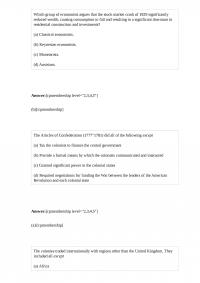
Which group of economists argues that the stock market crash of 1929 significantly reduced wealth, causing consumption to fall and resulting in a significant downturn in residential construction and investments? (a) Classical economists. (b) Keynesian economists. (c) Monetarists. (d) Austrians. […]
HST 66057
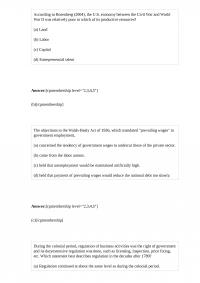
According to Rosenberg (2004), the U.S. economy between the Civil War and World War II was relatively poor in which of its productive resources? (a) Land (b) Labor (c) Capital (d) Entrepreneurial talent The objections to the Walsh-Healy Act of […]
HST 67143
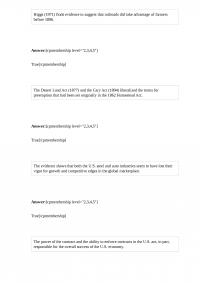
Higgs (1971) finds evidence to suggest that railroads did take advantage of farmers before 1896. The Desert Land Act (1877) and the Cary Act (1894) liberalized the terms for preemption that had been set originally in the 1862 Homestead Act. […]
HST 98226
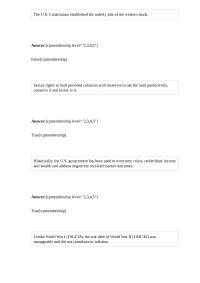
The U.S. Constitution established the orderly sale of the western lands. Secure rights to land provided colonists with incentive to use the land productively, conserve it and invest in it. Answer: True Historically, the U.S. government has been used to […]