Archives
978-0132770989 Chapter 11
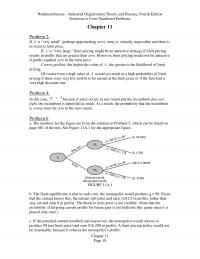
Waldman/Jensen – Industrial Organization Theory and Practice, Fourth Edition Solutions to Even Numbered Problems Chapter 11 Page 18 Chapter 11 Problem 2: If λ is “very small” (perhaps approaching zero), entry is virtually impossible and there is no need to […]
978-0132770989 Chapter 12
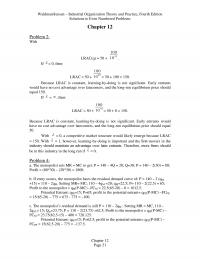
Waldman/Jensen – Industrial Organization Theory and Practice, Fourth Edition Chapter 12 Page 21 Chapter 12 Problem 2: With LRAC(q) = 50 + 1 0 0 1 0 λ q . If = 0, then: λ LRAC = 50 + 1 […]
978-0132770989 Chapter 13
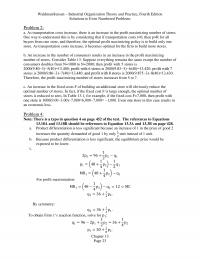
Chapter 13 Page 23 Problem 2: a. As transportation costs increase, there is an increase in the profit maximizing number of stores. One way to understand this is by considering that if transportation costs t=0, then p=R for all buyers […]
978-0132770989 Chapter 14
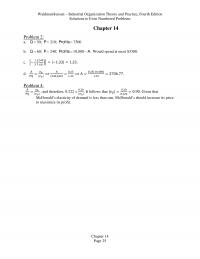
Waldman/Jensen – Industrial Organization Theory and Practice, Fourth Edition Solutions to Even Numbered Problems Chapter 14 Page 25 Chapter 14 Problem 2: a. 50=Q; 210=P; 7500=Profits b. 60=Q; 240=P; 10 800= −Profits , A. Would spend at most $3300. c. […]
978-0132770989 Chapter 15
Waldman/Jensen – Industrial Organization Theory and Practice, Fourth Edition Chapter 15 Page 27 Chapter 15 Problem 2: Before the cost-saving invention the monopolist’s profits were: Demand was: P=50-q; so MR=50-2q. To maximize profits set MR=MC: MR=50-2q=25; so q=12.5 and P=50-12.5=37.5 […]
978-0132770989 Chapter 16
Waldman/Jensen – Industrial Organization Theory and Practice, Fourth Edition Solutions to Even Numbered Problems Chapter 16 Page 30 Chapter 16 Problem 2: Note: We are ignoring the impact of fixed costs on profits in calculating the optimal pricing policy. Without […]
978-0132770989 Chapter 17
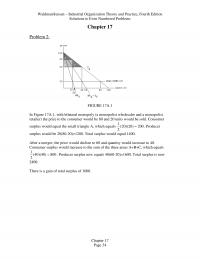
Waldman/Jensen – Industrial Organization Theory and Practice, Fourth Edition Chapter 17 Page 34 Problem 2: FIGURE 17A.1 In Figure 17A.1, with bilateral monopoly (a monopolist wholesaler and a monopolist retailer) the price to the consumer would be 80 and 20 […]
978-0132770989 Chapter 18
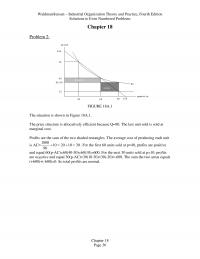
Waldman/Jensen – Industrial Organization Theory and Practice, Fourth Edition Chapter 18 Page 36 Problem 2: FIGURE 18A.1 The situation is shown in Figure 18A.1. The price structure is allocatively efficient because Q=90. The last unit sold is sold at marginal […]
978-0132770989 Chapter 2
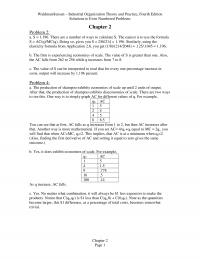
Waldman/Jensen – Industrial Organization Theory and Practice, Fourth Edition Solutions to Even Numbered Problems Chapter 2 Page 1 Chapter 2 Problem 2: a. S = 1.196. There are a number of ways to calculate S. The easiest is to use […]
978-0132770989 Chapter 3
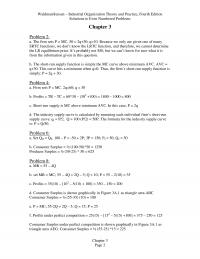
Waldman/Jensen – Industrial Organization Theory and Practice, Fourth Edition Chapter 3 Page 2 Problem 2: a. The firm sets P = MC. 50 = 2q+30; q=10. Because we only are given one of many SRTC functions, we don’t know the […]
978-0132770989 Chapter 4
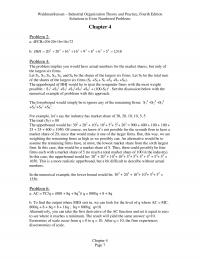
Waldman/Jensen – Industrial Organization Theory and Practice, Fourth Edition Chapter 4 Page 7 Problem 2: a. 4FCR=20+20+16+16=72 b. 518,1568916162020 22222222 =+++++++=HHI Problem 4: The problem implies you would have actual numbers for the market shares, but only of the largest […]
978-0132770989 Chapter 5
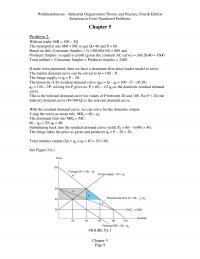
Waldman/Jensen – Industrial Organization Theory and Practice, Fourth Edition Chapter 5 Page 9 Problem 2: Without trade: MR = 100 – 2Q The monopolist sets MR = MC to get Q= 40 and P = 60 Based on this: Consumer […]
978-0132770989 Chapter 7
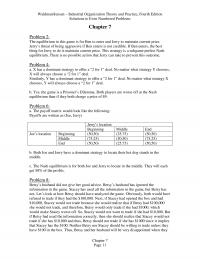
Waldman/Jensen – Industrial Organization Theory and Practice, Fourth Edition Chapter 7 Page 11 Problem 2: The equilibrium in this game is for Ben to enter and Jerry to maintain current price. Jerry’s threat of being aggressive if Ben enters is […]
978-0132770989 Chapter 8
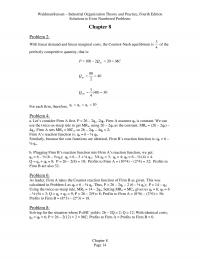
Waldman/Jensen – Industrial Organization Theory and Practice, Fourth Edition Chapter 8 Page 14 With linear demand and linear marginal costs, the Cournot-Nash equilibrium is 4 of the perfectly competitive quantity, that is: 30)40( 4 3 40 2 80 202100 == […]
978-0132770989 Chapter 9
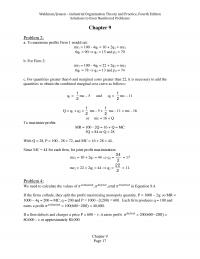
Waldman/Jensen – Industrial Organization Theory and Practice, Fourth Edition Solutions to Even Numbered Problems Chapter 9 Page 17 Chapter 9 Problem 2: a. To maximize profits Firm 1 would set: mr1 = 100 – 4q1 = 10 + 2q1 = […]