Archives
978-0123745071 Chapter 1 Private Value Autions A First Look
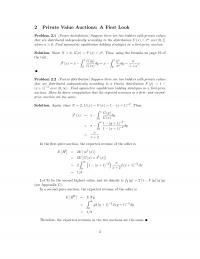
2 Private Value Auctions: A First Look Problem 2.1 (Power distribution) Suppose there are two bidders with private values that are distributed independently according to the distribution F(x) = xaover [0;1] where a > 0:Find symmetric equilibrium bidding strategies in […]
978-0123745071 Chapter 10 Equilibrium and Effciency with Private Values
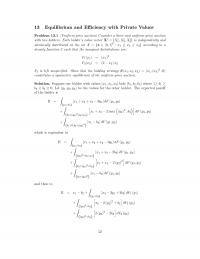
13 Equilibrium and E¢ ciency with Private Values Problem 13.1 (Uniform price auction) Consider a three-unit uniform-price auction with two bidders. Each bidder’s value vector Xi=Xi 1; Xi 2; Xi 3is independently and identically distributed on the set X=fx2[0;1]3:x1x2x3gaccording to […]
978-0123745071 Chapter 11 Sequential Sales
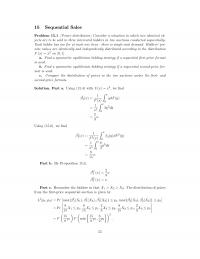
15 Sequential Sales Problem 15.1 (Power distribution) Consider a situation in which two identical ob- jects are to be sold to three interested bidders in two auctions conducted sequentially. Each bidder has use for at most one item— there is […]
978-0123745071 Chapter 12 Nonidential Objects
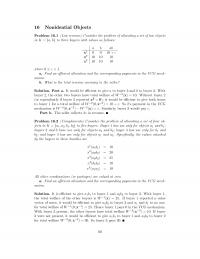
16 Nonidential Objects Problem 16.1 (Low revenue) Consider the problem of allocating a set of two objects in K=fa; bgto three buyers with values as follows: a b ab x10 0 10 + “ x210 10 10 x210 10 10 […]
978-0123745071 Chapter 13 Packages and Positions
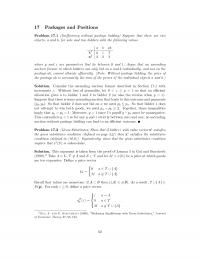
17 Packages and Positions Problem 17.1 (Ine¢ ciency without package bidding) Suppose that there are two objects, aand b, for sale and two bidders with the following values a b ab x1y z 2 x22 2 2 where yand zare […]
978-0123745071 Chapter 2 The Revenue Equivalence Principle
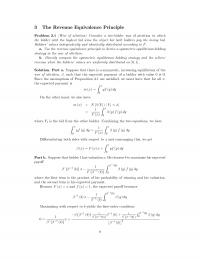
3 The Revenue Equivalence Principle Problem 3.1 (War of attrition) Consider a two-bidder war of attrition in which the bidder with the highest bid wins the object but both bidders pay the losing bid. Bidders’values independently and identically distributed according […]
978-0123745071 Chapter 3 Quali cations and Extensions
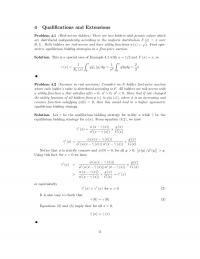
4 Qualifications and Extensions Problem 4.1 (Risk-averse bidders) There are two bidders with private values which are distributed independently according to the uniform distribution F(x) = xover [0;1] :Both bidders are risk-averse and have utility functions u(z) = pz: Find […]
978-0123745071 Chapter 4 Mechanism Design
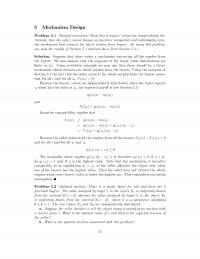
5 Mechanism Design Problem 5.1 (Surplus extraction) Show that if buyers’values are independently dis- tributed, then the seller cannot design an incentive compatible and individually ratio- nal mechanism that extracts the whole surplus from buyers. (In doing this problem, use […]
978-0123745071 Chapter 5 Auctions with Interdependent Values
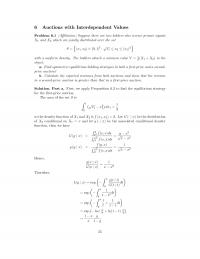
6 Auctions with Interdependent Values Problem 6.1 (A¢ liation) Suppose there are two bidders who receive private signals X1and X2which are jointly distributed over the set S=n(x1; x2)2[0;1]2:px1x2(x1)2o with a uniform density. The bidders attach a common value V=1 2(X1+X2)to […]
978-0123745071 Chapter 6 Asymmetries and Other Complications
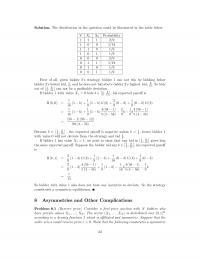
Solution. The distribution in the question could be illustrated in the table below V X1X2Probability 1 1 1 2/9 1 0 0 1/18 1 1 0 1/9 1 0 1 1/9 First of all, given bidder 2’s strategy, bidder 1 […]
978-0123745071 Chapter 7 Effciency and the English Auction
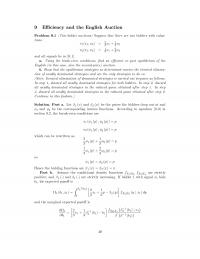
9 E¢ ciency and the English Auction Problem 9.1 (Two-bidder auctions) Suppose that there are two bidders with valua- tions v1(x1; x2) = 2 3×1+1 3×2 v2(x1; x2) = 1 3×1+2 3×2 and all signals lie in [0;1]. a. Using […]
978-0123745071 Chapter 8 Mechanism Design with Interdependent Values
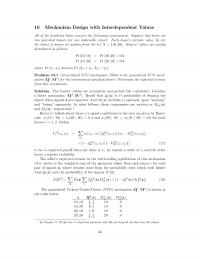
10 Mechanism Design with Interdependent Values All of the problems below concern the following environment. Suppose that there are two potential buyers for one indivisible object. Each buyer’s private value Xifor the object is drawn at random from the set […]
978-0123745071 Chapter 9 Bidding Rings
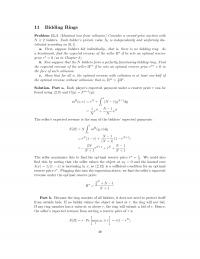
11 Bidding Rings Problem 11.1 (Maximal loss from collusion) Consider a second-price auction with N2bidders. Each bidder’s private value Xiis independently and uniformly dis- tributed according on [0;1] : a. First, suppose bidders bid individually— that is, there is no […]