Archives
BUS 152
Within a household, the allocation of labor to household production depends on: A. Relative marketplace wages. B. Individual preferences for household versus marketplace work. C. Relative ability at household production. D. The household utility function for marketplace versus household goods. […]
BUS 325 Suppose 40 percent of all
Suppose 40 percent of all potential workers are highly skilled and contribute $50,000 to the firm each year. The remaining 60 percent of potential workers are less-skilled and contribute only $30,000 to the firm each year. Schooling costs a highly […]

BUS 393 Midterm 2
A strike A. can be a rational response during the union-firm negotiation process. B. is a Pareto optimal outcome. C. hurts the firms management and share holders but not the union members. D. is never in the best interest of […]
BUS 563 Quiz 3
What happens to the piece rate if there is a ratchet effect? A. The piece rate decreases over time. B. The piece rate increases over time. C. The piece rate is replaced with a time rate. D. The piece rate […]
BUS 570 Homework
Suppose all 18-year-olds are identical in every way except that some have easy access to credit (i.e., they face a low interest rate when borrowing money) while others have a difficult time accessing credit (i.e., they face a high interest […]
BUS 855 Midterm 2
Consider a color-blind firm that is currently maximizing profits. An affirmative action policy is put in place requiring that all firms in the industry abide by a certain quota. Which of the following will occur? A. There will be no […]
ECB 259 Test 2
What is an example of the scale effect? A. Workers choose to provide more hours of labor when the wage rate decreases. B. Hiring more labor as long as the marginal product of labor is positive. C. The firm expands […]
ECB 384 Final
The union wage gap for private sector unions in the United States is presently on the order of A. 2%. B. 8%. C. 15%. D. 28%. E. 39%. If ability is positively related to schooling, then estimating the returns to […]

ECB 763 Final
An increase in non-labor income while holding the wage rate constant A. rotates the budget line out along the consumption axis. B. rotates the budget line out along the leisure axis. C. rotates the budget line in along the leisure […]
ECB 846 Test 2
A large employer gives each new hire an aptitude test, which is scored from 1 to 20. Let T be a workers score on the test. The firm then pays the new worker a wage of w = 0.6T + […]
ECON 204 Quiz 1
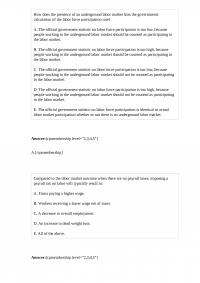
How does the presence of an underground labor market bias the governments calculation of the labor force participation rate? A. The official government statistic on labor force participation is too low, because people working in the underground labor market should […]
ECON 730 Midterm
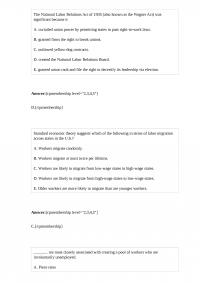
The National Labor Relations Act of 1935 (also known as the Wagner Act) was significant because it A. curtailed union power by permitting states to pass right-to-work laws. B. granted firms the right to break unions. C. outlawed yellow-dog contracts. […]
ECON 826 Compared to offering no
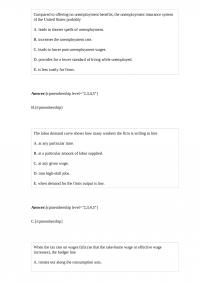
Compared to offering no unemployment benefits, the unemployment insurance system of the United States probably A. leads to shorter spells of unemployment. B. increases the unemployment rate. C. leads to lower post-unemployment wages. D. provides for a lower standard of […]
ECON A 220 Test 2
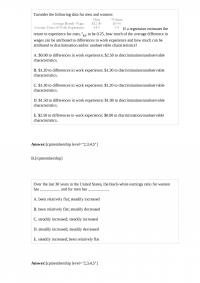
Consider the following data for men and women: If a regression estimates the return to experience for men, ²M, to be 0.25, how much of the average difference in wages can be attributed to differences in work experience and how […]
ECON A 693
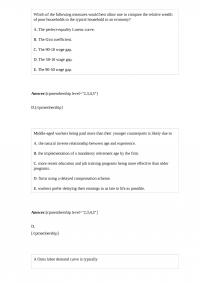
Which of the following measures would best allow one to compare the relative wealth of poor households to the typical household in an economy? A. The perfect-equality Lorenz curve. B. The Gini coefficient. C. The 90-10 wage gap. D. The […]

ECON A 717 Final
The equilibrium hedonic wage function is most likely A. horizontal as no firm will over-pay for workers. B. horizontal as firms will choose their optimal level of safety. C. a single point, as all firms will choose the same level […]
ECON E 680
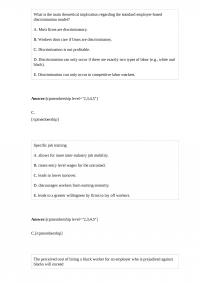
What is the main theoretical implication regarding the standard employer-based discrimination model? A. Most firms are discriminatory. B. Workers dont care if firms are discriminatory. C. Discrimination is not profitable. D. Discrimination can only occur if there are exactly two […]

ECON E 842
When graphing a workers indifference curves in Probability of Injury (x-axis) versus Wage (y-axis) space, Als indifference curves are steeper than Petes indifference curve. In this case: A. Al is more risk-loving than Pete. B. Al requires a greater wage […]
Economics 498 Quiz
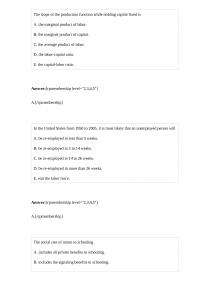
The slope of the production function while holding capital fixed is A. the marginal product of labor. B. the marginal product of capital. C. the average product of labor. D. the labor-capital ratio. E. the capital-labor ratio. In the United […]
Economics 583
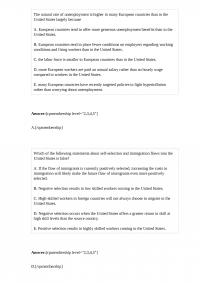
The natural rate of unemployment is higher in many European countries than in the United States largely because A. European countries tend to offer more generous unemployment benefits than in the United States. B. European countries tend to place fewer […]
Economics 719
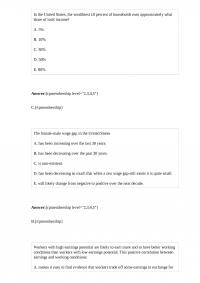
In the United States, the wealthiest 10 percent of households earn approximately what share of total income? A. 5% B. 10% C. 30% D. 50% E. 80% The female-male wage gap in the United States A. has been increasing over […]
MicroEconomic 298 Homework
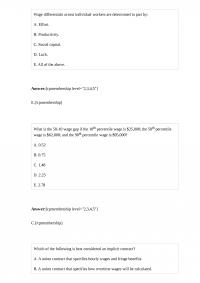
Wage differentials across individual workers are determined in part by: A. Effort. B. Productivity. C. Social capital. D. Luck. E. All of the above. What is the 50-10 wage gap if the 10th percentile wage is $25,000; the 50th percentile […]
MicroEconomic 892
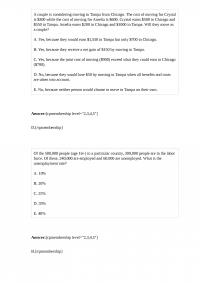
A couple is considering moving to Tampa from Chicago. The cost of moving for Crystal is $300 while the cost of moving for Amelia is $600. Crystal earns $500 in Chicago and $550 in Tampa. Amelia earns $200 in Chicago […]