Archives
ANT 22672
The typology of the French archaeologist Franois Bordes classified Mousterian tools into 63 types which occurred in set frequencies, creating four fundamental patterns. Bordes argued that these four patterns reflected four different cultural groups of Neandertals. Bordes’ typology: a. Assumed […]
ANT 61376
Which of the following is true of archaeological types? a. Archaeological types are assigned with the goal in mind of classifying objects in the same way that prehistoric populations would have classified them. b. Archaeological types are abstractions; the same […]
ANT 70250
Today, most archaeologists feel more comfortable using the following abbreviation when providing a date: a. BC b. BP c. AD d. BCE _______________ evidence usually provides dates for historical sites. a. Geomorphological b. Faunal c. Documentary d. Floral Answer: C […]
ANT 90192
The following were concerns regarding the excavation and conservation of the Hunley: a. The location of the Hunley was a mystery until a magnetometer was used to locate it. b. The ship would have quickly corroded unless it was sprayed […]
CGS SS 11386
When we say statistical population we mean a. A range of archaeological material across a landscape. b. A set of counts, measurements, or characteristics about which relevant inquiries are to be made. c. The region that will be sampled. d. […]
CGS SS 27791
The goal of middle level theory is to: a. Determine whether modern cultures accurately reflect prehistoric cultures. b. Identify gender through stone tool analysis. c. Help build secure inferences from archaeological remains. d. Identify the role of the individual in […]
CGS SS 77178
The 100 countries that have signed the UNESCO Convention of 1970 agree to: a. Regulate the import and export of cultural objects. b. Forbid their nations’ museums from acquiring illegally exported cultural objects, and return or otherwise provide restitution of […]
CGS SS 77348
Charles Lyell’s 1865 book The Geologic Evidences for the Antiquity of Man was important because it: a. documented the fact that humans had lived with now extinct animals in the distant past. b. provided evidence that humans had been on […]
SOC 17217
Physical, face to face associations of people are referred to by archeologists as a. Non-residential groups b. Residential groups c. Residences d. Non-residences How has Lewis-Williams explained the cave paintings at Lascaux? a. The paintings represented totems, from which lineages […]
SOC 17548
Custer’s “last stand” was immortalized in several paintings created in the 1890s by both Native Americans and white American settlers. The images created by the American whites generally show: a. Custer and his army being slaughtered by Lakota, Northern Cheyenne, […]
SOC 36942
The best place for a bioarchaeologist to look to determine the sex of human skeletal remainsis: a. The skull. b. The pelvis. c. The sacrum. d. The dentition. Studies of from various modern human populations have found: a. Living Native […]
SOC 40956
“Stratigraphy” is: a. The study of a site’s artifact assemblage. b. The thorough and detailed documentation of archaeological excavations. c. The procedure by which archaeological sites are professionally mapped. d. A site’s physical structure produced by the deposition of geological […]
SOC 77976
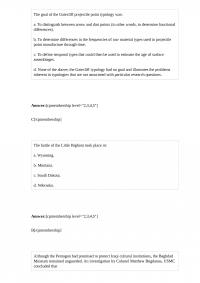
The goal of the Gatecliff projectile point typology was: a. To distinguish between arrow and dart points (in other words, to determine functional differences). b. To determine differences in the frequencies of raw material types used in projectile point manufacture […]
SOC 87842
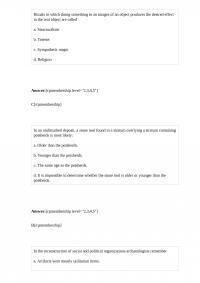
Rituals in which doing something to an images of an object produces the desired effect in the real object are called a. Structuralism b. Totems c. Sympathetic magic d. Religion In an undisturbed deposit, a stone tool found in a […]
Squier And Davis Contributed To Investigations Of The Moundbuilders By
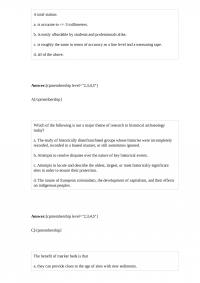
A total station: a. is accurate to +/- 3 millimeters. b. is easily affordable by students and professionals alike. c. is roughly the same in terms of accuracy as a line level and a measuring tape. d. all of the […]
SSCI 10273
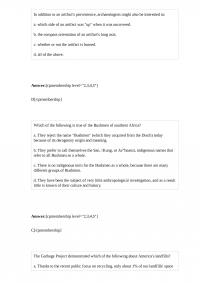
In addition to an artifact’s provenience, archaeologists might also be interested in: a. which side of an artifact was “up” when it was uncovered. b. the compass orientation of an artifact’s long axis. c. whether or not the artifact is […]
SSCI 46781
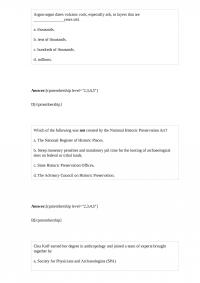
Argon-argon dates volcanic rock, especially ash, in layers that are _______________years old. a. thousands. b. tens of thousands. c. hundreds of thousands. d. millions. Which of the following was not created by the National Historic Preservation Act? a. The National […]
SSCI 57856
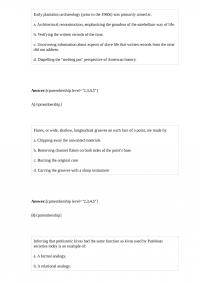
Early plantation archaeology (prior to the 1960s) was primarily aimed at: a. Architectural reconstruction, emphasizing the grandeur of the antebellum way of life. b. Verifying the written records of the time. c. Uncovering information about aspects of slave life that […]
SSCI 86434
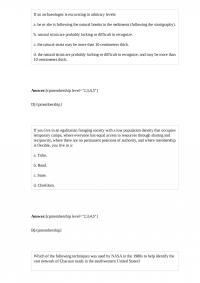
If an archaeologist is excavating in arbitrary levels: a. he or she is following the natural breaks in the sediments (following the stratigraphy). b. natural strata are probably lacking or difficult to recognize. c. the natural strata may be more […]
SSCI 88810
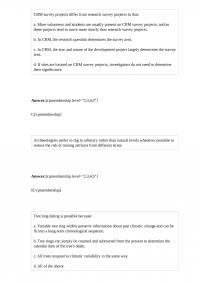
CRM survey projects differ from research survey projects in that: a. More volunteers and students are usually present on CRM survey projects, and so these projects tend to move more slowly than research survey projects. b. In CRM, the research […]