Archives
ECB 18237
What are the main features of the Harris-Todaro model of rural-urban migration? Answer: Explain carefully the opportunity costs of a mother’s time, what may lead these to change over time, and what effects these changes have on family decisions. Answer: […]

ECB 19042
The nominal rate of protection shows the extent to which the domestic price of imported goods exceeds (a) what the price would be without tariffs. (b) the cost of intermediate inputs. (c) the social opportunity costs of the good. (d) […]

ECB 54146
With modern sector enrichment growth, inequality will (a) first rise and then fall. (b) first fall and then rise. (c) remain about the same. (d) none of the above. Answer: The informal sector exhibits (a) free entry (b) labor intensive […]
ECB 71150
An individual’s demand for education is most affected by (a) direct and indirect costs of schooling. (b) development priorities of the country. (c) the desire to escape agricultural work. (d) all of the above. Answer: Sectors where the development process […]
ECON 47192
The best explanation for the late 1994/early 1995 collapse of the Mexican peso and stock market is (a) free movement of capital internationally is destabilizing for a developing country. (b) portfolio investments were camouflaging overvalued exchange rates. (c) debt for […]
ECON A 75986
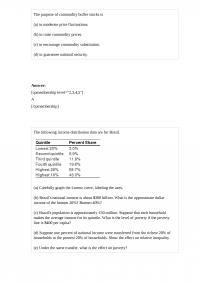
The purpose of commodity buffer stocks is (a) to moderate price fluctuations. (b) to raise commodity prices. (c) to encourage commodity substitution. (d) to guarantee national security. Answer: The following income distribution data are for Brazil. (a) Carefully graph the […]
ECON A 76428
Increasing GNP is a necessary but not a sufficient condition for improving living standards in less developed countries. True or false, explain. Answer: An argument supporting promotion of the urban informal sector is (a) the formal sector is incapable of […]
ECON A 94856
What is meant by the term technological spillover? Answer: Why are women often referred to as playing a central role in economic development? Answer: An answer should include how women can influence whether or not the next generation will be […]
ECON E 66692
In the North-South model, how are “basic factors” distinguished from “advanced factors,” and what are the implications for growth and development possibilities? Answer: Discuss some of the factors that lead infant manufactured goods industries to become more efficient over time, […]
ECON E 71723
Show in a diagram an S-curve and a 45-degree line. Are all three points of intersection stable equilibrium points? Explain. Answer: What is human capital and why is it crucial to expand human capital as part of the development process? […]
ECON E 93966
What are the three main indicators that make up the Human Development Index? Answer: Distinguish between economic growth by modern sector enlargement, modern sector enrichment and traditional sector enrichment. For each of the three cases, show what happens to absolute […]
Economics 23425
A plan that sets targets to cover all major aspects of the national economy is known as a/an _____ plan: (a) interindustry (b) complete (c) comprehensive (d) economic Answer: The system of land tenure in which tenant farmers pay a […]
MicroEconomic 30254
Comment on the following statement: The level and growth rate of real GDP per capita can be a misleading indicator of development. At the same time, countries that experience sustained increases in real GDP per capita over time will tend […]

MicroEconomic 37731
The poverty gap is the (a) absolute number of people below the international poverty line. (b) percentage of the population below the international poverty line. (c) consumption (measured in dollars) necessary to bring everyone below the poverty line up to […]