Archives
CAPP 44715
(*max)(num1, num2, num3);: a. Is the header for function max. b. Is a call to the function pointed to by max. c. Is the prototype for function max. d. Is a declaration of a pointer to a function called max. […]
CAS CS 73562
A function prototype does not have to: a. Include parameter names. b. Terminate with a semicolon. c. Agree with the function definition. d. Match with all calls to the function. Which of the following code segments prints a single line […]
CDA 30865
Which of the following statements is false? a. Variables or functions listed after the public access specifier (and before the next access specifier, if there is one) are “available to the public.” They can be used by other functions in […]
CDA 70428
________ helps Internet-based applications perform like desktop applications. a. Ajax b. Blogging c. RSS d. Mashups A function prototype can always be omitted when: a. A function is defined before it is first invoked. b. A function is invoked before […]
COMP 35589
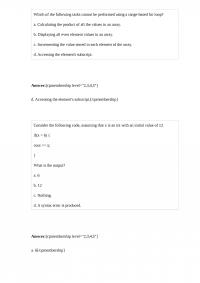
Which of the following tasks cannot be performed using a range-based for loop? a. Calculating the product of all the values in an array. b. Displaying all even element values in an array. c. Incrementing the value stored in each […]
COSC 66934
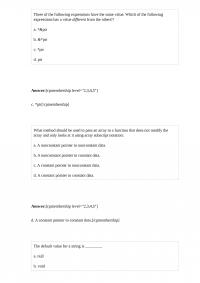
Three of the following expressions have the same value. Which of the following expressions has a value different from the others’? a. *&ptr b. &*ptr c. *ptr d. ptr What method should be used to pass an array to a […]
COSC 93659
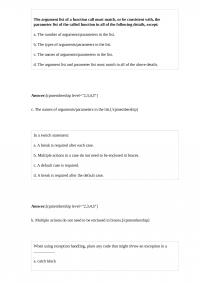
The argument list of a function call must match, or be consistent with, the parameter list of the called function in all of the following details, except: a. The number of arguments/parameters in the list. b. The types of arguments/parameters […]
CS 72233
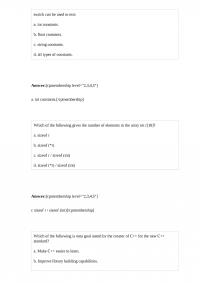
switch can be used to test: a. int constants. b. float constants. c. string constants. d. all types of constants. Which of the following gives the number of elements in the array int r[10]? a. sizeof r b. sizeof (*r) […]