ISBN 13: 978-1285195094
ANT 15339
In Federalist No. 10 and No. 51, Madison argued in favor of a large republic, which went against the ideas of this political philosopher. a. John Locke b. Thomas Hobbes c. Plato d. Montesquieu e. None of the above is […]
CGS SS 89245
The text argues that the U.S. Constitution had to reconcile a. the work ethic with the existence of a leisure class. b. a religious establishment with the quest for religious freedom. c. personal liberty with the need for social control. […]
ANT 21422
Many scholars argue that the foremost factor in determining how people vote is a. debate performance. b. perception of the best candidate. c. campaign spending. d. a candidate’s image. e. party identification. Political polarization among the American public is/was a […]
CGS SS 22010
Studies of how casualty rates affect public opinion show that as death rates rise, people a. develop more favorable attitudes toward the war. b. support withdrawal from the war. c. support surrender. d. support escalation in the fighting to defeat […]
SSCI 73442
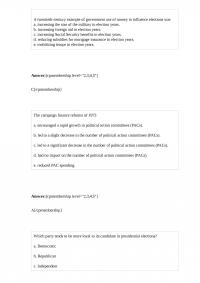
A twentieth-century example of government use of money to influence elections was a. increasing the size of the military in election years. b. increasing foreign aid in election years. c. increasing Social Security benefits in election years. d. reducing subsidies […]
SOC 14038
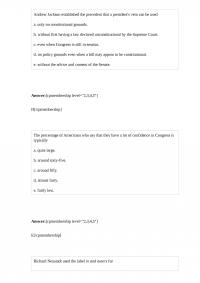
Andrew Jackson established the precedent that a president’s veto can be used a. only on constitutional grounds. b. without first having a law declared unconstitutional by the Supreme Court. c. even when Congress is still in session. d. on policy […]
ANT 34969
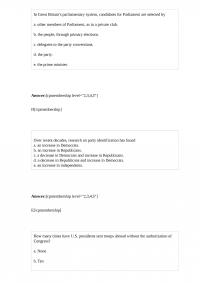
In Great Britain’s parliamentary system, candidates for Parliament are selected by a. other members of Parliament, as in a private club. b. the people, through primary elections. c. delegates to the party conventions. d. the party. e. the prime minister. […]
SSCI 90488
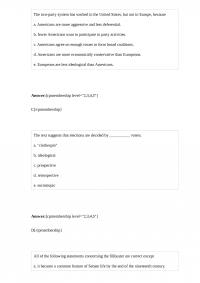
The two-party system has worked in the United States, but not in Europe, because a. Americans are more aggressive and less deferential. b. fewer Americans want to participate in party activities. c. Americans agree on enough issues to form broad […]